
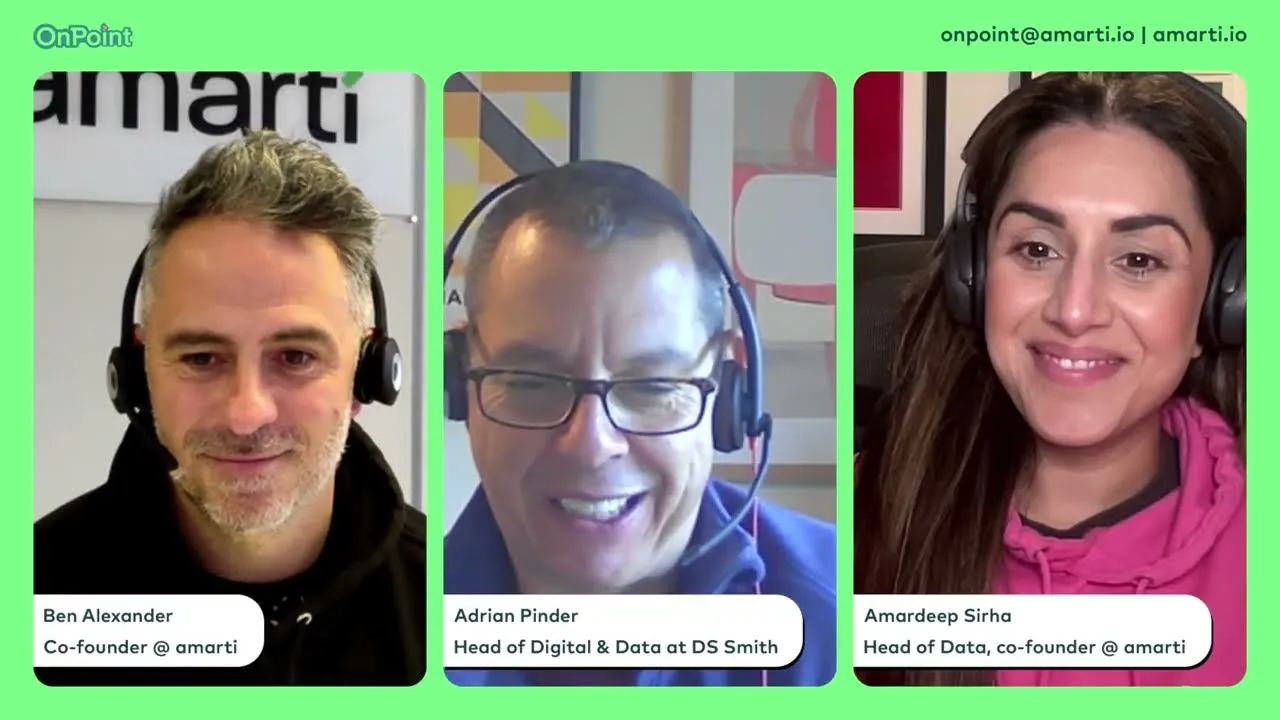
OnPoint S3:E1
Adrian Pinder (Head of Digital and Data at DS Smith)
Watch the full episode on YouTube
OnPoint is BACK for a brand new season of insightful chats and honest conversations from the world of data.
We’ve got some brilliant guests lined up for this season already, and we’re kicking off with a fantastic episode where Ben and Am are joined by Adrian Pinder, Head of Digital and Data at DS Smith.
On the show this week:
- Why stakeholder buy-in is essential when implementing a data strategy
- Methods to determine ROI when it comes to using GenAI
- Using value trees to prioritise a use case from the business
- And much, much more!
🎧 Listen to the show on Apple Podcasts and Spotify.
If you’d like to get in touch with the show, or if you’d like to be a guest on the next season of OnPoint, email us at onpoint@amarti.io.
Read the transcript
Automatically generated from the episode audio and lightly formatted for readability.
On this episode of On Point, we were joined by Adrian Pinder, Head of Digital and Data at DS Smith. Stakeholder buy-in is essential when implementing a data strategy. We cover this in detail, as well as methods to determine ROI when it comes to using Gen AI, using value trees to prioritise your user case in the business, and much, much more. If you'd like to get in touch with the show, or you'd like to be a guest on the next season of On Point, email us at onpoint@amarti.io. Now, on with the show.
Adrian, welcome to On Point. Thank you. Great to be here. Thank you for having me. Yeah, really lucky to have you on. Really interesting topics to discuss with yourself.
Could you start off maybe by just giving a brief intro to yourself, where you are at the moment? Yeah, sure. So, Adrian Pinder, Head of Digital and Data at DS Smith. Probably not many people have heard of DS Smith. We're one of those sort of major manufacturing companies that touches everybody's life, but you're probably not aware of us. So, we are a major sustainable packaging solutions business. The easiest way, I think, to describe us is if you've ever got an Amazon delivery, we make the box that your Amazon delivery comes in, plus millions and millions of boxes for customers around the world, mainly FMCG and industrial customers. So, about 300 factories across Europe, 30,000 people, about £8 billion of revenue. And we were recently acquired by an American company called International Paper. So, we're now a proud part of the International Paper Group, making us the biggest packaging solutions group in the world. So, that's me and DS Smith.
Super interesting. And I'll be completely honest, I hadn't heard of the business. But in my super geeky way, when I hear things like that, it's an incredible business and huge. So, really lucky to have you on. And the reason we've invited you on the show is because from previous conversations, as a business, you seem really quite far ahead on your AI journey.
And we're really interested in understanding how you've achieved this.
Sure. Yeah. So, it's, I mean, it's really nice to hear that we're ahead. I always think when you're in the foxhole, when you're kind of fighting day to day to drive change, it never quite feels like that because you're just kind of fighting the battles every day. But I think we've been working on Gen AI, both my team and across the company now, for about two years. So, it's not something that we've just sort of started.
And I always think sort of looking back, you sort of look back and think, what were the things that made the difference? What were the sort of decisions or inflection points that made the difference? And I think for us, there was probably three or four key things that we did in hindsight. The first was right at the beginning, about two years ago, we did essentially a training session for our board. So, this was, Chuck GPT had just arrived. The board were probably more concerned about it than seeing it as an opportunity. And they wanted to understand what were the risks and what did it mean for us. And we took them through both the risks, but also the opportunities of what ChatGPT and Gen AI generally meant for the company.
And that was a great session. We took about two hours to walk them through it. And at the end of it, I think they said, yes, you know, there are some risks. There are some things that we need to put in place, but also huge opportunity. Here's a little bit of a mandate for you, Adrian, your team to go forward and just start learning and experimenting and finding our way forward.
So, I think that was the first inflection point. What we then did before really kind of jumping into it too quickly was we then put a governance framework in place. So, worked with our legal department, with our data privacy department, working with the works councils in particularly Germany and France, working with HR colleagues. We put in place a fairly simple, it's like five or six pages, not hugely complicated at the time. But what I always say, it was kind of an MVP governance framework that really set the guidelines for what we would do in the first phase. And I think that allowed us to then sort of get going and sort of start to build some use cases, knowing that we were doing it within a kind of safe space. So, I think that was the sort of second key thing that we did. The third key thing was we just thought, look, let's just pick some use cases, right?
Let's find two or three low-hanging fruit that we felt we could sort of build fairly quickly. And it was, you know, literally weeks and not months to build things and that we thought would have value kind of really quickly. And we did sort of two or three, but there's one that really stands out, which was a translation tool. So, as a company, we were spending kind of, you know, millions of pounds on translation agencies to translate, you know, customer presentations or contracts or kind of key internal documents because we're in 35 countries. And we thought, that's a great application for Gen.ai, right? So, working with an external partner, we built a translation tool. You upload your PowerPoint. You upload your Excel, Word document. Pick your language.
Pick whether you want it kind of formal or informal language. And literally within five minutes, it sends you back a document, perfectly formatted, keeps the formatting. It now does about one of 30 languages.
And that's, like, not only is it saving the company now millions and millions of pounds because we're spending less on translation agencies. It's also allowing us to translate things that we would never, right, because we didn't quite have the time or maybe it wasn't quite worth getting an agency involved. But we can now do it, you know, everybody in the company can do it within five minutes. And so, that did a couple of things. It got sort of my team sort of comfortable with what we could build and the technology. So, we're an AWS house. So, we build on Bedrock. It got us comfortable with that. But it also got the company to see the opportunities and the impact. And that's now allowed us to go on and do a whole load of kind of new use cases. And now we're off and running. I love that one of the first tasks that you did was data governance because it's missed out so much just on if you ignore an AI journey just in data in general.
So, people don't trust the data and then they're really reluctant to do anything about the data. So, I think that is in itself a really forward-thinking thing to do, especially with the people that you engaged in that little session. Come out with like a non-complex version of it to then let people run wild with what they want to do in some parameters. Which has made me think about when someone said to me once, you need to let children fail. Just give them the parameters in which they can fail and then let them just carry on. And I think that's just so forward-thinking because I just don't think data governance gets enough play. So, first of all, that is really well done on that. And then I think the picking of some low-hanging fruit use cases to show value very quickly, which then instills faith in moving forward, which I think is really, really good. But I did have a question.
Having done that and been on the journey for a while in terms of the use cases, how do you decide now with your learnings whether a use case truly needs Gen AI or if it's traditional automation and how it will deliver better ROI, essentially? Yeah, exactly. So, great question.
So, you're right. So, we've done a few things. The first is we've now got quite a lot of use cases kind of coming towards us. So, at the beginning, we had to sort of go out and find them and unearth them. It's now sort of switched and we've got sort of people coming towards us with use cases and that's great. Which is great, yeah. Which is great. It's like we've got… Exactly what you want, yeah. That's the confidence. That's the confidence now because you've done it for the start. That's the difference. It is. Yeah, exactly. And there's never enough, right? I always say we want to be like completely overloaded. There's never enough. But we do have people coming to us saying, hey, we've seen what you've done over there. Can we look over here? Can we, you know, can you help us with this?
So, the first thing I always say is like let's just get a list. Let's rank them, right? And you've got to have a place to kind of capture the use cases so you know what you're kind of looking at. The next thing is ultimately you've got to decide it on ROI. I mean, that should really be the kind of the main metric that you look at. What's the return on investment that we're going to get here? And sometimes that's easier than others. I think we hit on when we pick the translation tool, we actually picked on a really interesting point that we hadn't realized at the time, which was with the translation tool. It was money that we were spending out of the company. So, we were spending it on kind of third-party agencies. So, every time the tool was used, potentially it was less money going out of the company for agencies. So, it was really easy to track that value.
And we've done some other use cases where it's reducing third-party spend. And I think they're really good use cases to prioritize because they're easy ones to show the value to the CFO, right? The ones where you're saving people internal time, basically helping productivity. They're great. But the question the CFO always asks is, what are people doing with that extra time? Yeah. If they're just making another cup of tea, then you're not really saving it's money. Yeah. So, you should still definitely do those use cases because they can be transformational, but it's harder to sort of get them signed off. So, definitely do it on ROI.
What we found is you have to have quite a close relationship and discussion with the business team to actually get to the bottom of what that ROI is because it might not be clear on kind of first discussion, right? What often happens is people come to us and say, look, we've got this pain point. Can you help us fix this pain point with Gen AI? And that's great. Always come with a problem, right? Always start with a problem, not a solution. But then when you unpack that pain point, you actually find other pain points like attached to it, right? Yeah. Or we end up saying, look, we could fix that with a little solution. But actually, if we just go a little bit upstream and a little bit downstream, we can transform the whole process that you're doing. And then it's like really starting to multiply the benefits and you're transforming whole processes and workflows rather than just an individual sort of problem. And that's where the real sort of impact comes from. So always look for ROI. Work really, really closely with the teams to try and understand what that ROI is and then see if you can transform the whole process.
And then essentially, it's trying to find the balance, right? So you want kind of some projects where it's quick wins. We know we can turn it around in a few weeks. It might not be the biggest ROI ever, but it's still positive. It still meets the hurdle rate. We can just churn those out. And then you want to match that with some that are much more kind of transformational that are going to sort of take longer, but where the impact is much higher. And then maybe the final thing I'll say is what we're also trying to do as a team is to work out where can we kind of productize what we're doing.
So there's an absolutely great solution that we've developed called IDP, Intelligent Document Processing. So we process, as you can imagine, kind of millions and millions of invoices from suppliers. Some of them come in through the post and we have to scan them. Some of them get emailed as a PDF, right?
But we have a lot of people kind of looking at paper records and, you know, taking off key information like supplier address or VAT number. We've developed a Gen AI solution called IDP that will just take off all the key information that you want from an invoice and spit it into SAP. And you don't have to tell it, like, customer address is always top left or VAT number always has these sort of codes. It's sort of learned that itself. So we've developed that for kind of one or two applications. And now what we're doing is trying to turn that into a platform, into essentially a product. So for the next application that needs it, we're not rebuilding it time after time. We're just putting a thin layer of customization on top. So it's build it once, roll it out a thousand times if you can do it. And again, we want to prioritize those use cases because we've built the platform.
The build is small. We want to kind of run and run and prioritize those. So it sounds like with some of the easier use cases, you just do a little bit of total cost of ownership to figure out, you know, where the value is going to come from in terms of ROI. And then it sounds like with some of the other ones, because I was going to ask, like, how do you define value from Gen 8? But it sounds like it's a little bit of everything. Speed, cost reduction, quality, new operational adoption. And then it sounds like you've gone a layer above that or down that, whichever way you would look at it. And also almost built yourself something that you then white label internally without white labeling it and then roll it out and roll it out. So it's repeat. It's like repeatable patterns, which is which is great because it's obviously cost saving as well.
And it allows engineering functionality and business functionality to understand and be used to how it's used as well. Yeah, yeah, agreed. So I sort of slightly drive my team mad a little bit by saying, like, you can always put a number on something, right? So we've developed a sort of a value calculator that my team use with a whole load of, you know, drop down boxes and kind of tick boxes and everything. So when a business person comes to us and says, well, if you develop something like this, it would save time and it would, you know, improve quality and would increase sort of customer stickiness. We've got a kind of value tree that we can follow and take people down and say, for instance, OK, you say this is going to increase sort of reduce customer churn. So, like, talk us through that. How many customers? What percentage of customer churn have you got at the moment?
What do you think you could reduce that to with this tool? What does that equate to in terms of additional kind of product sales? And we have a sort of relatively sort of complicated now value tree that we can sort of walk people through. And at the bottom of each tree is kind of you can always get to a number. Right. And people say, oh, this will improve quality. OK, tell us what your failure rate is today. Right. What does that failure cost? What can you get it to? And we try and build the business case up sort of bottom up. You don't always know the number. Right. You end up putting a range. Yeah. Some things. But that at least allows you to sort of get a feel for, you know, at the worst case, the ROI would be this. At the best case, the ROI would be that. Do we still want to do it?
I think there's so many businesses that would like. Sorry. Sorry. Sorry. I've got to interrupt. There's so many like CDOs, CTOs that would love to do what you're doing there. That value tree sounds like they don't have enough people coming to them in the business because the confidence and it's broken from the start. This is why it's really interesting for me because, you know, at the moment, the market in general, I find that there's more scrutiny from CFOs on getting signed off on particular projects. And it should be the opposite way around, really. But because I guess that maybe since COVID, when there's a huge investment in data, maybe they haven't seen the return on the investment as quickly. Yeah. And that's what's kind of kicking this off. But like I say, you're in a situation where you're not necessarily trying to say the best solution is to save the biggest amount of money. Let's build something that shows some real value, get some confidence from the business.
And then the business start coming to you with more ideas that are ultimately going to save the company more money. And it's great. And I just, like I said, I think people will be listening to this thinking, right, great. How do we build our own value tree? Yeah. And I think it's going back to what you said where you said that this is the pain point, but let's look upstream and downstream. And when I try and explain that to, like, especially if I'm doing a pitch and I'm talking about, you're looking at it holistically. And how I explain it is this is the pain point. This is the pain, but there's a lot of suffering that happens. There's suffering that happens upstream. There's suffering. So where you're suffering your whole journey, let's fix the whole journey instead of just panicking and saying, this hurts. Let's go to some root cause analysis and let's look where else you're suffering because that then builds the different, I guess, is how you've been able to then build out the different value trees because you're looking at all the different suffering, which I think is really, really, really good.
I had one question on that, which was, how do you, I mean, I don't know if you do have any, but do you have any current bottlenecks like model quality or the data quality or human adoption? Is there any bottlenecks that you still struggle with? So I wouldn't call any of those bottlenecks.
Sometimes we struggle on, look, you always struggle on data quality, right? That's every digital job I've ever done. There's always sort of data quality issues. You sort of get around that.
The models at the moment, you know, I mean, as I say, we're on bedrock. So generally, Claude is our preferred model, works out of the box.
That's also one of my messages to the company is like Gen.ai works. Yeah. Right. You know, you hear a lot of people talking about hallucinations and I'm not going to use it for hallucinations. I always give the example of my mobile phone, right? So I live in Derbyshire. I, you know, go to the office twice a week. I know that my mobile phone doesn't get any reception on the line from Derby to London. Does that mean I've thrown my mobile phone away and never use it? No. It just means don't make any important calls when I'm on the train for an hour between Derby and London. The rest of the time, it's fine. Yeah. So every technology has its, you know, its places where it's really strong and places where it's not quite strong. And we, you know, in business, you work around that and you use it where it's strong and you don't use it where it's not strong. And we're learning that with Gen.ai, right? Brilliant. If it's a super critical application, then there are things you can do to reduce and, you know, diminish hallucinations like RAG. But if it's super critical, maybe that's not the right technology.
But, you know, I always say, like, people make mistakes. I mean, God, I make mistakes all the time. But as a company, we've sort of learned to live with them.
So I wouldn't say there's any major bottlenecks. The sort of the biggest bottleneck is like any new technology, just getting it spread into the business, getting that change adoption to happen, right? People to feel comfortable with it, to understand the benefits, to want to go on that journey and just to get over the switching barriers, right? You know, again, I always use the mobile phone analogy.
Every time a new iPhone comes out, does everybody switch? No. You wait, right? You wait until, I don't know, you're at the end of the contract or you've dropped your phone and it's broken and you've got to upgrade. Or, you know, a new feature comes out that you really want to have. But nobody switches automatically when the new phone comes out. There's a reason people switch at some point in time later on after the release. And so it's working out with the business units when's the right time for them to switch from what they're doing today to what they can do tomorrow with Gen.A.I. Yeah. And that's partly education. It's partly helping them go on the change process. It's partly making sure we as a tech team are having the right conversations and explaining the technology in the right way. And frankly, not pushing technology that's a bad fit for people. Yeah. And that's on us as well as a tech team.
And I think that goes back to you originally doing that sort of data governance piece as well, which will have included maybe some frameworks of where to use it and where not. So I'm just going back to hallucinations. So it seems like you've got some sort of frameworks for evaluating hallucination risks deployed in Gen.A.I. So have you got some frameworks that work for you? We do. So generally we use RAG. So we've used sort of RAG. And then for some of the other applications, we've sort of chained the LLMs. So you've got kind of three LLMs sort of, you know, sort of checking each other. But the main architecture we use is RAG to sort of reduce hallucinations. But we're not finding that's a major kind of problem.
When we've rolled the solution out, generally people love it. People are adapting to it. People are liking what we're delivering. And I think back to a point that you made earlier on, what we're also finding is I sometimes slightly get told off at work for using this phrase, but it's almost like Gen.A.I. is a little bit of a sort of gateway drug that just gets people hooked on kind of wider digital and data journeys. Right. If you want to talk about data governance, no one gets excited about data governance. I do. I do, Adrian. But apparently no one else does. There's a few strange people in the world excited about it. But like nobody, nobody when they're 18 said to the careers teacher, I want to be, I want to work in data governance. Yeah. But like people are excited about Gen.A.I. They really want to do projects. They really want to learn. And we're finding we're having richer conversations, you know, deeper conversations with the business because it starts around Gen.A.I.
That's the little gateway drugs that gets them addicted to digital and data. And then once we're starting, we can then have a wider conversation around, you know, actually, we could fix this by Gen.A.I. Or we could fix it by just integrating those two solutions. Or actually, we'll put a digital workflow in place as well with a bit of data governance. And that'll get you even more value. But we'll just talk about the sprinkles, the Gen.A.I. stuff on top. Because that's how people, you know, that's the sexy thing. Yeah. Is there any assumptions that you had about Gen.A.I. At the beginning of your journey to that now you don't believe anymore? Yeah. That's a great question. So, I think maybe a couple of things. I think when we all started, we didn't think the technology would be as good as it is. Particularly those of us who are a bit like me, who are a bit older, who sort of, you know, were working through the dot-com boom.
When the technology probably wasn't quite there, you know, in the 2000s when the Internet was exploding. Like, frankly, there just wasn't the bandwidth. So, there was all of these companies who were building fantastic valuations on companies that needed, you know, big bandwidth that wasn't there. So, I think a lot of us in tech had kind of grown up thinking as soon as the technology is launched, the technology is not quite ready and the world has to catch up. Whereas it is there for Gen.A.I. For 90% of what you want to do, it works out of the box. So, I think that's one thing that surprised us. The second was, like, just how easy and quick it is to get going and to build really impactful solutions that make a difference. So, I say to my team, look, if we're doing something that takes more than a month or two, forget it. We're doing the wrong thing.
Like, we should be, you know, the project should be measured in weeks, not months. Yeah. Yeah.
I often speak to, well, I speak to CTOs and CDOs, CIOs, that kind of level all the time in technology.
And quite a sentence I hear often, and I'm going to swear because, A, I'm from Leeds, but B, this is how they say it, is I often hear them saying, I just want them to fucking build it. Just start fucking building. And I think that's so, like, that's not one person that's said that to me. That's so many people have just said, just start fucking building it. And if you fail, pivot. And if you fail, pivot. Yeah. And if it's taking you, and if it's now taking you three months, scrap it and start again. And I think maybe there was a time in the last sort of five to ten years where people were afraid to do that and we all became like that. And now it's that freedom again of, like, no, no, no, you're being led by saying, just start building, just start something. So I think the fact that you've been able to get that in the organization and people are on board, the board is on board, they're hooked on it as well.
I just think it's just going to set you off in such a, like, not fast, but you're going to start running, but in a really, in a good way. You're not going to run and start falling straight away, which I think is really, really important. The benefits of the board buying, isn't it? I think with a lot of other companies, it's a cultural change. And I think that's really hard to do. But the way that you've worked it with the quick wins, I think that's just, I think it's, I think if anyone's taking something from this, who wants to get, too often we're involved in coming into a project where the business isn't ready. There's a big piece of work behind actually planning and speaking to everybody and different departments as well. And departments that aren't technical because tech have kind of run away with something and their finance aren't going to be using the system and they're not.
And they've got to get, you know, how are you going to get them up to speed? And I think that that's the main difference with what you've done. Because sometimes there's huge programs, but quick wins, fixing something and getting that, that is what everybody should be taking from this. You know, it really is, it, God, I make it sound simple. It is that simple. You know, it's, I think that from an operator, you know, I've got, there's businesses speaking to a CTO last week and they're rolling out a new strategy for next year. Global business and, and tech and, you know, tech are on board. They've worked closely with the board about this. And then the business leaders are on the call. And, you know, I think like the US is like, yeah, we'll be ready for this next summer. And then, and other people are kind of, oh, I don't know, but they're, it's because they're nervous and they shouldn't be, but because the way that you've approached it, if they had over a period of time had the smaller, quicker wins, I think you can just going to get the buy-in.
And obviously how you've done it is, is absolutely spot on. So it's a kudos to you. Yeah. And I think that building on that, Ben, there's, there's, I think some people and some organizations still have this fear that Gen AI will replace traditional software development, but actually I believe it will rewire how we approach it rather than replace it. And if you go into that kind of mindset and you become fearless, you'll just rewire traditional software development. And it's always been rewired, actually. It's always been rewired. I think the difference is now the, the non-tech person, it has access to it. Whereas 20 years ago, a non-tech person would be like, oh no, it's technical. I'm not even touching it. Whereas now we're seeing AI used in households for household tasks, you know, it's just a lot more accessible. So I think if people shift their mindset into it's rewiring instead of replacing, they'll be more open and less fearful.
And the conversation just start flowing. Yeah. I mean, a hundred percent completely. I mean, I, my background is in sort of digital product development that for major engineering and sort of manufacturing companies. That's my background for the last sort of 10 years or so. I do say previously it was, let's not build anything until we've like completely got the specification. We know all the customer requirements, right? All of the sort of classic sort of sprint stuff. And I think that was right at the time, but we're now in a different era where you can just develop things in two weeks. You know, see if there's something there, capture the value and then just, just keep building.
And the way we did it. So I've got a sort of not a large team, sort of a fairly small, small kind of technical team, like absolutely fantastic team. And like, I love them to bits. At the beginning, we got a third part, a third party in just to build a couple of those early kind of use cases. And I think that was the right thing to do because that meant, A, we got going really quickly. But B, also my team could sort of learn quickly from the third party.
And now we sort of build things ourselves. We've always got a couple of sort of third parties in the house who are our build partners. But now my team have got that core knowledge. They've got the core engineering skills. They know what works for us. They know what doesn't work. And they can direct the vendors to sort of build in the right way.
Yeah. I think that's really important. And I also think like there's always going to be BAU. So if you can rely on a third party or other engineers, however the organization is set up to do the BAU, then they can do the sexy stuff, which is what all engineers want to do. They want to do the sexy stuff. They want to do the fun stuff. Exactly. And actually, as a permanent employee that's on their career, why shouldn't they be doing that? They should be doing the innovative stuff. And if you need to lean on a third party for some skill set, that's cool. But I think once you bring that knowledge in-house, that specialism in-house, they can really run with it. They're really, truly passionate about the organization. And they understand them. The key thing is they understand the products and their customers. Far better than anyone external ever. So I think it's great that you can still lean.
But let's leave the people in-house to do all the fun bits. I think that's a great way of looking at it. Yeah, exactly. And they're like, you know, we all try and get into the office on a Thursday. Right? They're in the T-point talking to the business people, talking to the business leaders. And saying, hey, I was playing around with this thing last night. Like, is that useful for you? Oh, that's really interesting. So we've got the sort of my tech team just talking day-to-day with business people. Telling them what the new technology can do. Yeah. And like we're getting use cases at the T-point. Yeah. Because the conversation's happened. And they're off like trying to develop it. Yeah. And I think we forget that in all of this kind of race in AI, it's exciting. Like everybody's excited about it. It's the first time technology is being talked about in circles that it would never have been talked about.
So it's exciting. And people are excited to see how they can use it and how it can better their life and how it can better their day job. And it's just brilliant. I think you've really smashed it in terms of the journey. And I do want to go back to the fact that it's probably because you put the data governance guardrail.
I think it is that. I think that. I mean, the data governance stuff is interesting because we sort of… I mean, so wants to bring it back to data governance all the time. We try and make the conversation sexy. And then she just keeps on drawing it back to the governance, doesn't she? It is interesting, though, because we go backwards and forwards on this, right? And sometimes I read… You read a lot on LinkedIn with people saying you've got to sort your data out before you do Gen AI, right? Don't start anything until your data is sort of perfect. I'm not sure I agree with that because I think if your data was perfect, actually, half the time, you probably wouldn't need Gen AI. I mean, I can think of some of the really good use cases that we're working on at the moment. And we're kind of doing them because our data is not perfect, right?
Yeah. I mean, it's not a total train wreck. It could always be better. But actually, Gen AI can help you on that data journey. So, a lot of things around knowledge management where you're using Gen AI to kind of search and to sort of pull back different bits of information from different kind of sources and put it together. I say to people, like, don't spend the next two years sorting out your data because the train will have moved on. Like, get the value now. Yeah. And get Gen AI in there. What you do need is, like, the right guidelines and the right governance framework. There is. So, one thing we did very clearly when we did our MVP governance framework was that we're not going to do anything with HR. No personal data, no HR data, right? We're not going to use Gen AI to look at CVs and recruitment, nothing. No HR stuff. Because we knew we had so many other use cases in, you know, operations or supply chain or kind of finance that we very quickly said, no HR.
We put that in the guidelines, no confidential information. And that gave us the guide rails to go off and experiment. Do what you wanted. Yeah. Because you're not worrying about PII then, are you? No. Yeah. And we're not worrying about, you know, HR constantly going, oh, my God, digital team. What the hell are you doing, right? Yeah. You know, all of this public data. It was like, no, no, we're not doing anything with personal data at all. Brilliant. So, if you had one piece of advice to give other organizations that maybe are a little bit fearful or just worried about them missing out on this train zone, what would you say to them? Yeah. I think, as we've talked about, just find a use case. Find a use case and just start. I think if it's a use case where you're basically doing external spend, you know, you're spending with marketing agencies or translation agencies where we were, they're really great because you can immediately see the value.
If it's productivity, it's hard to see the real impact on the bottom line. Find a use case where you're spending real money externally.
Either just hire a couple of really smart people or work with some of the great third parties like you guys who are out there who can get you going. If the project is more than a couple of months, you've picked the wrong one. Like, you know, six, seven weeks max. Just build something and roll it out and see what it does, see the impact, see how people get excited about it, and then just do the next one. I say to my team, solve one problem at a time. Solve one problem, move on to the next one. Keep going. Brilliant. So many key takeaways from this. Really, really appreciate your time. I'll say it to everyone who's on the show. So I kind of fear that maybe you'll get inundated, to be honest with you, but obviously this goes out onto LinkedIn.
Are you happy for people to reach out, to connect to you? Yeah, sure. Yeah. I know you're on the circuit, aren't you? You do some events and bits that people might see you around, and I'm happy to come up and ask you these kind of questions. Yeah. So, look, for anyone in tech, this is the most exciting time in my career I've ever seen, right? And we know, like my team know, like half a percent of what there is out there. So we want to learn, and we want to learn from other people who are ahead of us so we can keep getting better. Well, thank you very much for your time. We really appreciate it, and yeah, we look forward to catching up with you soon. Great. Thank you. Thanks, guys. Thanks, guys. Thanks, guys. Thanks, guys. Thanks, guys. Thanks, guys.
Thanks, guys.