
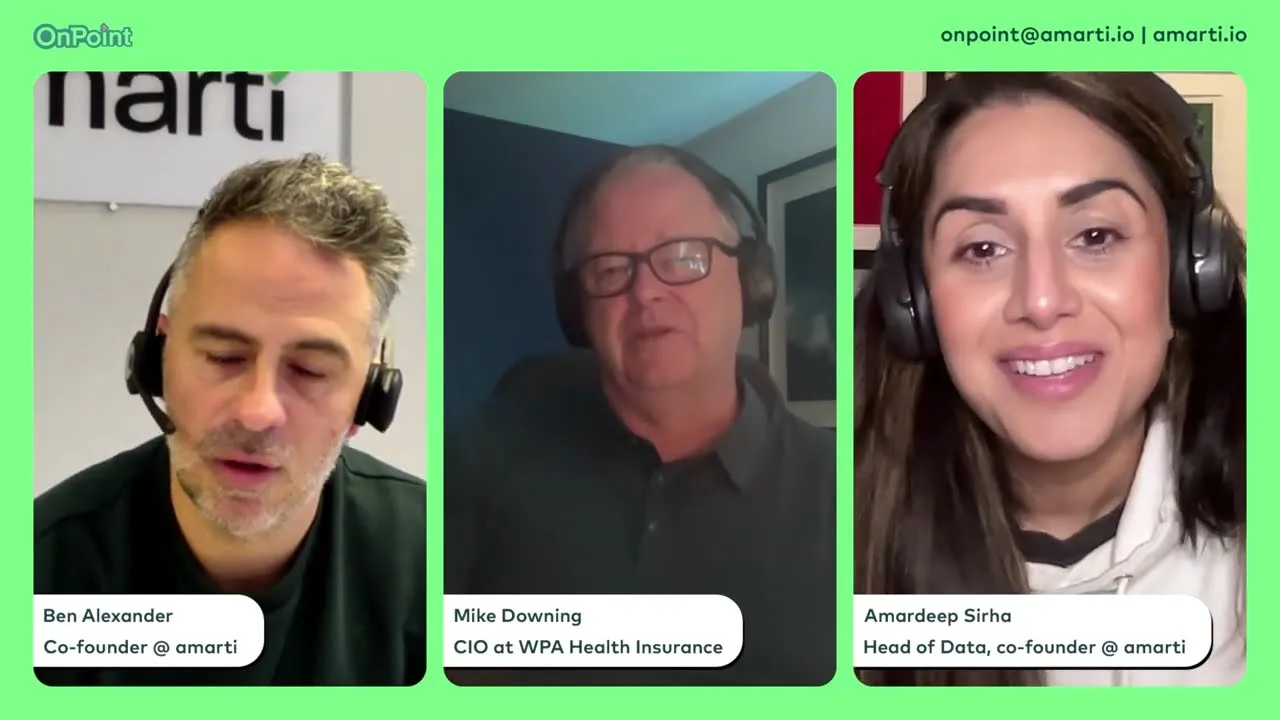
OnPoint S3:E2
Mike Downing (Chief Information Officer at WPA Health Insurance)
Watch the full episode on YouTube
This week, Ben and Am are joined by Mike Downing, Chief Information Officer at WPA Health Insurance.
Mike joins us to talk about:
- How WPA developed their own Small Language Models in-house
- What this means in terms of being in control and developing feature-rich language models
- A look ahead about what’s coming up in AI adoption and bespoke AI trends
- And much, much more!
🎧 Listen to the show on Apple Podcasts and Spotify.
If you’d like to get in touch with the show, or if you’d like to be a guest on the next season of OnPoint, email us at onpoint@amarti.io.
Read the transcript
Automatically generated from the episode audio and lightly formatted for readability.
On this episode of On Point, we're joined by Mike Downing, Chief Information Officer at WPA Health Insurance. Mike joins us to talk about how WPA develop their own small language models in-house, what this means in terms of being in control and developing feature-rich language models, a look ahead of what's coming up in AI adoption and bespoke AI trends, and much, much more. If you'd like to get in touch with the show, or if you'd like to be a guest on the next season of On Point, email us at onpoint@amarti.io. Now, on with the show.
Mike, welcome to On Point. Thank you. Thank you for inviting me. Something that Amadeep and I have been really interested in recently is speaking to businesses that are actually building their own AI. So really interesting, some of the key drivers behind WPA building their own AI. Yeah. Just filling a few things about WPA. So UK Health Insurers serving personal lines, corporate, large corporate. We very much pride ourselves on our customer service, so everything's about improving that customer experience wherever we can. We've got a relatively unique strategy in that we build the majority of our own software, which is sort of different to the market. To do this, we've got a large tech team internally and a small number of partners. So we build instead of WPA for several reasons. We want to be in control of our own destiny. We want to manage costs. And we want to be able to build the features that matter.
So that's how our go-to is to build our own software. So if I look back in time, some of the things we've built in the AI space, around 2017, we built a claims and treatment engine, mix of machine learning and traditional approaches. Around 2018, we automate our back office, bit of deep learning and traditional code. So very much using AI as it was then. Now with the advent of recent developments, in 2023, we started reworking the back office processing using agents with LangChain and LangGraph. This went live in early 2024, and we've built our capability on it month on month. This means a great deal of that repetitive work is now undertaken by agents. So we've got teams of agents running on each area of the back office. Traditional sort of task-based approach. So because we built out our own AI solutions with the sort of current thing, we wanted to go to the next level.
So one of the things we built was a call center co-pilot. Now, if you're on the call center, you speak in the customers all the time. We want to make that experience really, really good. So we support those generic questions and those customer-based questions as much as we can. There's a lot to remember when you're on the phone. So having that call palette to assist you helps you with that journey. So all of these solutions I've mentioned so far, we built in our secure cloud environment.
Across the business, people are using things like GPT as a learning and strategic tool. That's pretty much embedded now throughout the organization.
Our developers make extensive use of AI tools. So we're well on that journey of using AI. Looking at the market and where it's heading, we believe that SLMs, so small language models, so more specialized, rather than large language models, the generic, it can do anything, are going to become more and more important as the agentic AI movement continues. So most of our agents so far have been task-based. I see the agentic approach as mission-based. So define a role, give it a job specification, definition of tasks, access to tools, and then a definition of the mission. Then these agentic solutions can be put to work. So one concern that we have, and this goes back to our build versus buy, is we don't want to be locked in with the tech giants. You know, their AI is perfect, it's general purpose. But we really don't want to be reliant when the costs start to rise. And, you know, that's not where we go to. So we need greater control over our destiny, our costs, security, privacy. Again, aligning with that build versus buy, fundamental. I can go into the journey so far.
Yeah, that's great. I've just got a couple of questions if that's okay.
I heard you say that, well, your engineers are kind of, they've got the freedom to explore different AIs, explore different tools to obviously make everything run more smoothly, and be essentially quite innovative at WPA. A lot of organizations, especially when ChatGPT first came out, they were like, you can't use it, you can't use it, and everybody panicked. I'd like to just understand how your organization and your leadership team leaned into that, because that's what's then set your innovative journey off and made the engineers and all the people in the organization feel, I suppose, secure in being an innovative, right? Yeah. So I think part of this is our history of AI solutions.
We've had AI in its older term capability for a while, so people are comfortable with AI systems running. When GBT and others became available, yes, we wanted the controls, so we've set policy in place. It's an enterprise license, so we don't want people just using things across the internet. Yeah, of course. But very much controlled. We give access to tools within our secure cloud environment, so then we know things are not leaving, let's say. That's really great, and I guess that's what's propelled the journey now, and for you guys to be, I guess, leading in a sense of where you can go with AI and how far you can take it if you're already thinking about the next steps, which I think is really, really brilliant. It's about embracing, I think the commercial tools, it's about embracing them as almost a co-worker. Yeah.
Well, it's a tool, isn't it? It's an addition to your skill set rather than it becomes the skill set. But they've also increased in capability so much. They've only been around, what, two years? Yeah. And it's gone from text to text, text to, I don't know, video and things like that. And then now it's a planning and strategic tool. You know, you can use it to help you do your work. And so you – oh, sorry, go on. I was going to say, so as far as the rollout, we very much target the thinking areas of the business. Yeah. So, yeah, if you're on the call, send up, we will produce applications for that. But if you're doing this sort of a strategic role, these solutions, the GPTs and the like, are very good for helping you think, helping you come up with solutions. And I think that's the key, isn't it? Help rather than do it all.
And I think what's really – I think you should go out and tell everybody how you do it because it sounds like you've got a really, really robust AI strategy that, I guess, underpins and goes across the organization. It's not just that siloed in a data and AI team. It sounds like the organization has a very clear organizational strategy, which then other strategies can then go up into and roll up into that, which means that everybody's on the same path, which is really, really brilliant. Have you found that the vast majority of people in the organization and the culture of the organization has grown with the direction you're taking in AI and being the masters of your own kind of destiny? Or do you think that's had to be a culture shift as well? So we've – I've been at WPA for 26 years and we constantly – again, because I think we build our own software, we're constantly striving for the next thing that will give the customers the better experience, the better journey.
So I'd say there's constant change. We continually challenge ourselves to improve what we do. And I just see AI as another part on that journey. Yeah, I absolutely agree. Yeah. I agree. So looking at the environment that we find ourselves in, other companies will be going on this journey. So it's very much something that you can't put off. And I suppose then your data that underpins all the AI and the innovation that you're trying to do is already in a state which it's governed and it's trustworthy and the business trusts the data and you're happy with the data. Is that a journey that you went on yourselves as well? So we were quite lucky because we built those earlier machine learning systems. That data was in a perfect state to start using. Yeah. We've had to build out other data, for example, for the co-pilot. There are other areas of the system that need a data tidy before we can sort of implement AI solutions there.
But one way I look at this, if you take the abstraction approach, so the underlying data can remain as is. Yeah. But you can always abstract it to a layer that is more workable for the tools. Yeah. Agreed. And is that the focus? That's what you focus on then? Not necessarily the raw data, but the layer. And do you differentiate those layers depending on the tool or is it a layer that can be then pulled up into different tools?
Differentiate depending on the solution that we're working on. Yeah. Oh, that's really brilliant. I just wanted to lean into the call center a little bit because I think that's really, really interesting. It seems like your WPA is really bleeding AI where it's beneficial across the whole organization. And I think the call centers across any organization in the world that uses a call center, that's where they really want to drive operational efficiencies. And because that is customer facing, essentially. What are some of the benefits you've seen from using co-pilot along your call center staff? And have they been open to the journey to go on that journey? It's early days on that. We are just rolling it out. Business is very aligned.
I think the biggest benefit besides efficiency will be accuracy. Yeah. Because there's a lot to remember. There's a lot to learn. And if there's an assistant that's helping you with those questions and answers, that's perfect. Or some sort of functionality that we've built into the co-pilot.
Generate data extracts, for example, to send to a customer, like their claims, their treatment, their invoices. Now, that could take an hour today. With the co-pilot, it takes seconds. Yeah, that's just brilliant. It's just brilliant. And I think it – I guess it would give – like I'm a customer of WPA, so I've got lived experience of interacting. Oh, snap. Yeah. When I call up when I call up when I need to use the services. And I've got to admit, there's never been a situation where I've been put on hold for even several minutes while they try and find some sort of information. I also have my son on the insurance, which means I have to – I mean, he can't call up because he's a baby. But, you know, if I've ever done anything with him, it is very quick. I suppose it gives the call centre employees such confidence as well when speaking to customers that they're not going to be frustrated that, oh, God, my system's taking age.
So I'm just going to pop you on hold and I'm going to just – Yeah, exactly. More than anything, the system's taking such a long time. It sounds like you're in such a healthy position and really driving it forward. Have you ever thought about sharing some of those practices and learnings with other organisations, especially in healthcare, where, you know, we need it in healthcare, right? So have you ever shared some of those with, like, wider, I guess, colleagues that you've – in the healthcare industry? But we're very open on sharing our stories, sharing where we've got to.
Yeah, it's something that we do without a doubt.
Sorry. No, no, no. I have to jump in because Adams is hogging the show now. This happens. But I think – Yeah, no, sorry. I'll just keep going. The really interesting thing, Mike, is that you've been in the business for such a period of time and this is a really – it's a long-term strategy. So this is how – like, I think this is – it's not a surprise to me that you've been building your own software and then you've led into this of building your AI.
I know you said earlier on that you're talking about maybe a little bit of the other background stuff. But another key thing would be lessons learned, you know, because over such a long period of time, there must have been some bumps in the road and maybe a little bit of a re-strategising. How have you coped with that? How have you dealt with that? There always is. So what we could automate 20 years ago compared with now is, you know, it's a whole different story. I think it's about horizon scanning, understanding what's coming, being willing to change. We've got a culture that sort of embraces that.
And that's probably worth talking about sort of our next steps on this because, again, we've got some solutions, but we're looking to the next sort of iteration now. So we've purchased a number of multi-GPU machines. Again, we want to control our own destiny around the AI tooling. We've started using these to build our own small language models.
We've built a generic model that can converse. Now we're making specialized versions of these SLMs. So one may be clinical. One may be specialized in our rules. One may be specialized in some of our data sets, which goes back to what we were talking about, the data extraction layers. So in time, I see these.
So the agentic AI approach combined with SLMs combined with the agentic orchestration layer coming together to have agentic operations across the board coming together as teams to solve problems.
And again, we're building all of this out ourselves. Yeah, that's brilliant. And I guess you're kind of forming an ecosystem of collaborating SLMs, right? And could you think of that as almost like federated intelligence?
Exactly. And as I said, we're building our own SLMs, but we're also using open source SLMs. I think there's a tech race going on between the open source capability and the tech giant capability. And there's a bit of leapfrog going on there. So the open source or our own SLMs being used for the agentic approach gives us that specialized capability. It really does. It really does. And we've taken this now further. We're very much targeting different job roles in order to become more efficient. So if a team of agents can review a number of cases, for example, produce the top 10 cases that a human should look at, that to me is a massive win. On the coding side, we've built out a solution, again, using this orchestration layer, using multiple open source SLMs that knows our entire code base. It can answer questions on that code base for business analysts or developers. And we run trials on it.
So our backlog of requests, we allow this team of SLMs, of agents, to look at the backlog, come up with solutions of what it thinks it needs to be done. When the developers have done those same changes, we compare, and the accuracy is very good. So I see in time this solution will be making changes on our code base. That's brilliant. So do you think that, for example, in your organization at least, the SLMs will eventually become as common and invisible as embedded chips? Like they're everywhere, but they're unnoticed? In time, and it's not going to happen overnight, but in time, they will become invisible.
People won't think, oh, the AI is doing that. It will just happen automatically.
That's really great. And I suppose there's going to, I suppose at some point, and maybe this is further down the line, or maybe it's something you might be exploring anywhere, there's going to be like an economic inflection point where deploying lots of SLMs actually becomes cheaper than API calls to larger models.
Exactly. Exactly. And if you look, if you think about that coding system that we've built, the price of some of the AI coding tools is increasing and increasing. Well, that runs at basically no cost to us for licenses and things like that. Yeah, because obviously you've got that, you've got your kind of masters of your own destiny as well. You've got the ownership. It's just so interesting watching, like for me as well, that didn't start her career in technology. So, you know, I've only had like 10 years in it versus some people that, for example, yourself, that's had 20 plus years. But just seeing how fast things change, like first it was, like I remember the kind of API gateway, API gateway, API gateway. That was like the thing. And then it was large language models, LLMs, LLMs. And it's just so interesting. But this AI race, as you said, is just, it's incredible.
I watched, it was at the Google's kind of, when they do their little presentation of all the new things that they're doing and what they're bringing out, and I was, have a friend that is really into AI, and he just sits and he codes most of the time. And he's built a model, which is incredible. And when I was watching the Google release, I was almost like, oh, my friend's built that. But I think much better, like he's shown me this. He's shown me how it could work for me in my own life just because he's so interested. And I do think it's going to be this incredible race. I went to Big Data London a couple of weeks and everything. I can't, like, not necessarily the talks, but the stands was just agentic AI.
And it actually became a little bit overwhelming where I was like, oh, like I'm going to stop speaking to them because it's just the same thing being sold to me. It's just so interesting that you've taken control. I love the fact that you've taken the control and you can really steer the direction in which you want that to go in. I think that's brilliant. And I hope that more organizations have the confidence to do that and the leadership to support them doing that. I think it's brilliant. Ben, I know you're sorry. And what I'd say to that is, I echo what Ams is saying, but then I think that from Ams's friend's example of an engineer who wants to be in a kind of business that has that longer term strategy and has, you know, it's not an off the shelf product. Like, this is the kind of environment that people want to work in, Mike.
So, you know, kudos to you. In terms of – and it's an incredible story and really interesting. What advice, if there's another business in insurance or not that's now looking at having a bit of a change and looking to build more internal themselves, what advice would you give to somebody who's maybe thinking about that at the moment? I think there's two splits here. You can go with the tech giants. You can buy – you know, you can get embedded in that. I totally believe in the build angle. I've seen a lot of agentic AI frameworks come into market. You know, they're everywhere now. There is a charge to them. There is, you know, you don't really know what's running under the hood, let's say. So, I think organizations should focus on developing their own AI orchestration layer. I'm sort of biased on that.
At the end of the day, a lot of these commercial tools are using the same underlying frameworks like Lanchain, Lanchgraph that you can use yourself. So, there's a choice to be done there. Having it built by your own team, you get that internal expertise being used on it. You can also – the other thing which I think is key – by using small language models that you built yourself, all fine-tuned, together with the setting up of some of that agentic approach. It's working for your domain. It's not general purpose. Yeah.
It's specific, isn't it? Yeah, yeah. Exactly. So, I think no matter where you run it, this will have some sort of cost efficiency.
There is a little bit of a movement in the market as well to being able to demonstrate what your solutions do. So, by the bias, decision transparency, you need to understand what these things are actually running. So, if you buy an off-the-shelf solution, you don't really know what's happening under the hood.
And I think especially in the financial services area, the regulators are going to have more of a look at this. So, if I've got a agentic solution that's running on our own SLMs, on our own kit, and I can explain through the various toolage that the explainability and the decisions that it's making, I think that stands out better than we're calling GBT through a framework that we bought. And this is what happens? We think. Yeah.
It is interesting because the industry needs to move along with the organisations. And you're right. I'm just thinking about financial industry. But anyway, that needs to report externally. I mean, it doesn't even have to be financial. Do those regulatory bodies understand? Yeah. And even if it was explained to them, do they understand? Oh, exactly. So, they're probably going on their own journeys to just educate as well themselves. And hopefully they are. So, that when people explain how you're using different things in the organisation, when it comes to AI, machine learning, etc. You know, you're there. I'm hoping that eventually it's going to get to a point where the vast majority of organisations have at least moved away from the phrase, we don't trust our data. You know, where a lot of organisations are still stuck, in all honesty. They might feel left behind as people race, are in the AI race. And, you know, they're suddenly just trying to put AI on top of it, on top of messy data and unclear data.
So, I think it's going to be really, really – I think the next sort of three years are going to be very, very interesting because it's just such a race. And I don't know if you know anything about it, but I've started looking at quantum AI in quite some detail. I think there'll be some – are you smiling? So, I'm glad you at least know you're on the same page as me. Definitely a massive geek, I am. But I am thinking about some of the organisations in the video, the people that are already laying down some foundations, because I feel like that's going to come very quickly and just hit us in the face. So, it's great that to hear, like, an organisation like WPA, especially in healthcare as well, which I'm quite passionate about, is doing something so exciting and forward-thinking, because then it's going to be ready. Like, you will be ready for the next step, whatever that step looks like.
Yeah, I think – I always think of it as a journey. So, there are areas of our system that are older, so very much we're looking to modernise them, rework them, just because we know how much it will matter in three years, five years' time, with the changes around everywhere. But, but equally, with this sort of build approach, with this conscious thing, we need to be in control of our own destiny. I think we need to be independent of any frontier model cost, because becoming reliant on them now as an organisation, if the costs start to escalate, start to accelerate, you will see your licence costs go through the roof in time. Oh, 100%. Yeah. 100%. And quite often, different organisations – I won't be specific – they'll start with a sort of fixed pricing, a tiered fixed pricing licence model, and then very quickly change to consumption-based. And then suddenly, that's where people are often like, oh, my God, and now we've implemented all this infrastructure.
We're completely reliant. We want to move faster. We do want to consume more. We want to have more customers. We want to run queries faster. And suddenly, our consumption costs are so much more higher. Well, the licensing, everything, the costs are just significantly higher. And now, the cost efficiencies we're supposed to achieve in this transformation are no longer – or this evolution are no longer there. Whereas for us, we know we just need to buy another server, which those servers are not cheap. No, they're not. But we understand if we want to do twice as much, buy another server. Buy another server. But with also – I'm just – Sorry, sorry, Ben. Being the referee sometimes with AMS. But you touched on it a little bit there, Mike. But what is next? What is – you know, what does the next, I guess, year or two look like from an WPA perspective?
Continuing, obviously, the journey that you're on. Yeah. So keep on building out those SLMs or open-source SLM capability. So we build out vertical AI, so this is agentic, job-focused, doing more and more of the back office. We modernize the system, especially those areas where the data is a bit challenging.
So modernize that. And all of this will come together. So what we need to focus on is anything we build now, for example, the agentic orchestration layer, needs to work in today's system and the system in three years, five years' time.
There's no use in rewriting everything every year because, you know, you've changed something. So it needs to be very open. And I particularly like the way you can offer up tools as part of this, too, once you define the tasks and the tools. Those tools could be APIs, you know, just to get the right data surfaced. And that's another angle is even if you've got data that's challenging, an API is an abstraction layer on that that surfaces up that data then in a much more usable format. Yeah, just being open-minded. It sounds like you're just open-minded to whatever is the right thing to do at the time. Yeah. Yeah, refreshable. There will be changes on the journey. There will be pivots without a doubt. The other thing I see coming is user interfaces are changing.
The traditional forms-based user interface. I think there are so many people now where using LLMs has become routine. So they will use it for decision-making, self-improvement, research, and anything. So that's – I forget the percentage of people who are using it daily now. But that has become normal to type into a chat interface no matter what the task is. Yeah. So I see a point in the future where people are using those sort of interfaces to do work, to activate agents, to give agents commands. And if you do need that form to – I don't know – edit some data, I see that being generated on the fly. Yeah. Rather than a whole UX, sat there, never being used. Yeah, I always find it interesting that when the little chat bots became very, very popular when you open a website or an app. And how frustrated we got as a human race. I don't want to speak to a bot.
And people are speaking to a bot every single day sometimes about very, very personal things as well. Which I think is great if it's helping. But, you know, some people are having whole conversations with bots about potentially their mental health and how to better themselves and stuff. And it's just such a – it's such a human cultural shift from landing on a website and saying, oh, God, I don't want to talk to this bot. And now we're really – that interface has changed. It's a really good point, actually, thinking about the front end. I think because the experience – so if you're talking with an LLM, that whole experience has changed from a rigid bot question and answer format to an actual conversation. And, yeah, most of them know a lot more than we do about things. So it can help you with just reasoning and decisions and whatever. I think you're quite right. There is a growing use case for emotional support and self-improvement and all that thing.
And I like it because it does make it accessible for a lot of people that might have had some barriers to entry into supporting their mental health. Whether it's financial or fear or whatever that looks like, you've got a space where you can at least try and gather some information. It can go out and get all the data it needs and provide you with some options, which is really good. And, of course, there we are talking about general purpose rather than specific sort of job role. And I think that's getting your head around that where specialized solutions can really help efficiency and customer experience and delivering what the customer needs. As opposed to a general purpose tool that can help you in so many ways in your daily life. Yeah. But equally, the more and more people embrace these in their daily life, they'll expect them in the office. Yeah. Agreed. Agreed. Or they'll use it in the office.
Yeah. Whether they're allowed to or not.
It's an exciting time without question and everything that's coming next. But, Mike, I think the really kind of key thing that I've taken away is, like I say, the long-term strategy that you've had and how the continuous improvement and how you're looking to carry this on over the next couple of years. We obviously have quite a big platform. There's going to be people who are going to be listening to this who are going to be super interested in how you've done this, how you plan. Even down to the kind of culture, because I think it's a completely different culture to different businesses. Are you okay with people? This obviously goes out on LinkedIn. Are you happy for people to reach out on LinkedIn and connect and ask some questions? Really appreciate that, because I'm sure there'll be some people who will take a lot of value from this. Mike, thank you so much for coming on. You've been a fantastic guest. Thank you. Thank you, Mike. We look forward to seeing you at a data event very soon.
And, yeah, thank you again. Thank you. We're on. We're on. We're on. We're on. We're on. We're on. We're on. We're on. We're on. We're on. We're on. We're on.