
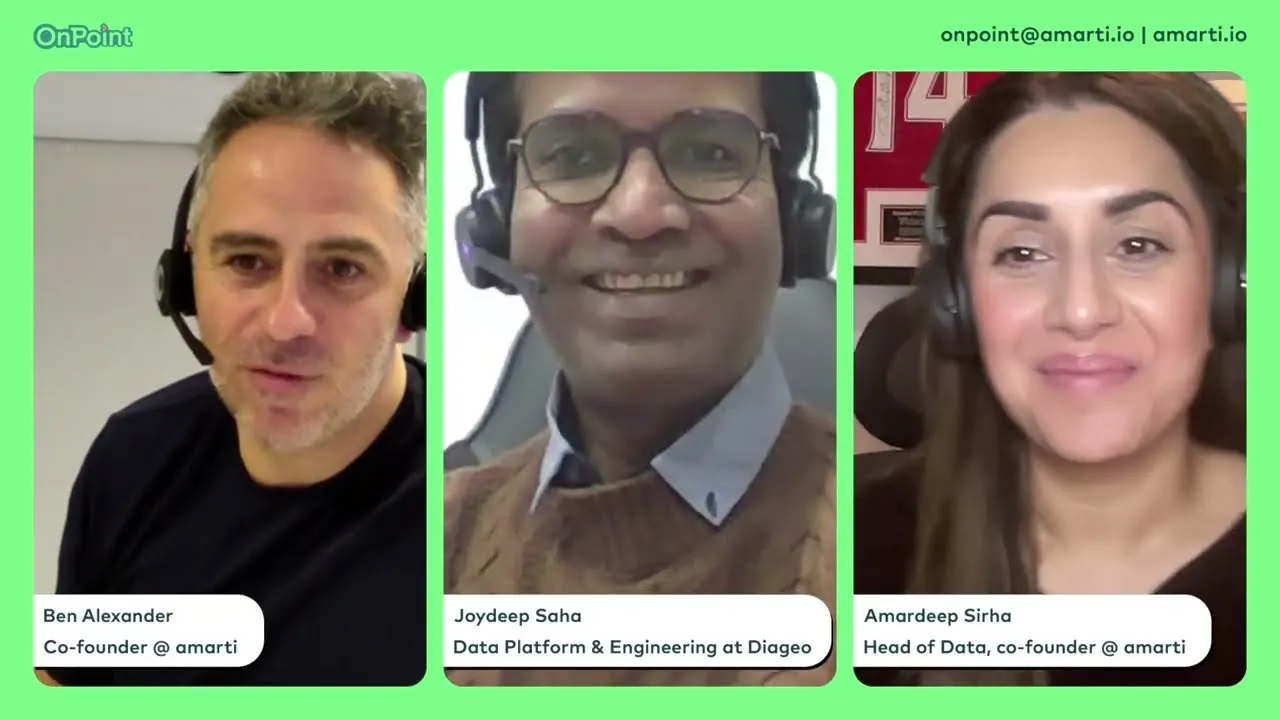
OnPoint S3:E3
Joydeep Saha (Head of Data Platform & Engineering at Diageo)
Watch the full episode on YouTube
On this episode of OnPoint, Ben and Am are joined by Joydeep Saha, Head of Data Platform & Engineering at Diageo.
Joydeep joins us to talk about:
- Not falling into the hype of AI
- Why investing in data ownership and data literacy helps everything falls into place
- Why you should start with a low risk, high impact AI project to show business value
- And much, much more!
🎧 Listen to the show on Apple Podcasts and Spotify.
If you’d like to get in touch with the show, or if you’d like to be a guest on the next season of OnPoint, email us at onpoint@amarti.io.
Read the transcript
Automatically generated from the episode audio and lightly formatted for readability. Speaker labels for this transcript were generated automatically from voice analysis and lightly verified by hand -- they may not be perfectly precise.
Ben Alexander: On this episode of On Point, we were joined by Joydeep Saha, Head of Data Platform and Engineering at Diageo. Joydeep joins us to talk about not falling into the hype of AI, why investing in data ownership and data literacy helps everything fall into place, why you should start with a low-risk, high-impact AI project to show business value, and much, much more. If you'd like to get in touch with the show, or you'd like to be a guest on the next season of On Point, email us at onpoint@amarti.io. Now, on with the show. Welcome to On Point. Hi, Joydeep. Hi, Ben. How are you? Doing really well, thank you. Thank you for coming on. Really appreciate your time today. We always start with a nice introduction. I can never give it justice. Would you like to introduce yourself to all the listeners?
Joydeep Saha: Yeah, sure. So, my name is Joydeep Saha. I have been into the IT industry for over 22 years now. Currently, I am working with Diageo. My role is I'm the Head of Data Platform and Data Engineering. And I look into the overall strategy of data platform implementation in the company. And there, I have quite a big team, which is probably around 50-odd people, which is globally distributed and working different time zones, different regions. And yeah, and quite integrated with the ambition that we have in terms of becoming a data-driven company.
Ben Alexander: Fantastic. Thank you for that. I'm probably a big customer of Diageo. I've got to be honest with you. It's coming into Guinness season now. And you probably have a lot of data on me. I wanted to, in this podcast, we wanted to discuss how organizations of different sizes implement an AI strategy. So, simple question to start off with, how do you think organizations are encouraging AI to be part of their strategy? It depends on the size of the organization. It depends on the breadth and the width of the organization. So, of course, if the organization is smaller, don't spread across into multiple countries. Don't spread across into multiple regions. The complexity is less.
Joydeep Saha: But bigger organizations, you will find a lot of complexity. There are reasons behind it. The aligning the strategy across different business units, aligning the strategy across different businesses, like the working structure of the businesses across countries can be very different in a big organization. So, your business strategy can differ by regions, by countries, by domains, business domains as well. So, that makes it more complex in bigger organizations. So, you have to, can you really standardize the way that you want to implement your AI strategy? That's the question here. For smaller organization, I think the complexity is a lot less. Another aspect that organizations realize, tend to realize once they start actually implementing AI is that implementing AI is not cheap. And hence, there has to be a side-by-side, well-established technology strategy that has to be laid as a foundation for your AI success. And on top of that, there is another aspect that is your data strategy. That also has to be considered very foundational. Why? Because technology is fine. You can choose your technology. You can implement following a certain pattern and architecture that is also one time. You can get it right and you can make it flexible as you go along. Data strategy is quite important because if you don't get that right, you identify or you kind of come across very late that actually you have implemented a lot of stuff, but you are not able to really drive value out of it. And then going back to the drawing board, try to redraw the stuff, it's really painful. One of the biggest points here when we talk about data strategy is how do you really ensure that the quality of data that you are bringing in is acceptable. If you get that right upfront, more on the left side, you are fine. If you don't, then you realize all the problems a lot later. So yeah, I think that is how organizations have to break it down. And as I said, that smaller organizations, the variety and the veracity of the data that they kind of have to deal with is a lot less. So implementing a strategy and sticking to it is probably feasible for a longer period of time. Of course, organizations do grow so you can expand. But for a big organization to really get it right at the first time is very difficult. And that's where all these things have to align with each other, your business strategy, your technology strategy, and then your data strategy.
Amardeep Sirha: So if really good points that I'm going to be a little bit contentious now. But if we just strip out AI for a second, how realistic is it that in lots of different organizations that even aligned with their technology and data because strategies, because quite often we go into organizations and their data strategy is not even aligned with technology at all. And then neither of them roll up into the business strategy. And then what you find is somebody will start saying, we need to use AI, we need to use AI. And it actually they and you're right about it being costly because they then embark on this massive journey, this AI strategy, this AI journey, which is great siloed. But the technology doesn't underpin the data, the data doesn't underpin the technology, and neither of them underpin the AI. So for organizations that might be starting those conversations are probably already are starting their organizations. What do you think they really need to focus on first before they even think about AI? Would you say it's a business strategy? Or would you say, or
Joydeep Saha: would you say it's everything, like think about strategy across all areas first? The point that you said about a lot of organizations, right, I think the first thing first is organizations have to first make sure that they don't get driven too much into this noise of AI hype. Okay, I am a data person, I love AI, but you got to be conscious of the fact that doing too many things at the beginning wrong can really cost you a lot. Okay, so you shouldn't really get driven into the fact that a lot of AI hype is there, every organization, and from the top down, there is a lot of push that we have to use AI. Okay, otherwise we are kind of failing. But we have to take a step back and really look into our business strategy to start with. Really, where do we really want to use AI? Okay, there are various ways of looking into it. One is that for your business growth, find out the areas where actually you can use AI for your business growth. And there is another place to really look into it. That is business efficiency. Okay, so and when I say business efficiency, I'm talking about internal, external both. Okay, internal in the sense that how do you really work on a day-to-day basis? How do your different units work in a day-to-day basis? Can you integrate AI there to expedite their work? That adds a lot of value. That adds a lot of cost efficiency. A lot of cash flow generation happens from there as well, right? So look into the low impact. I wouldn't say these are low impact. These are high impact, but low risk areas, right? Yeah. I think that's the best place to start with. Okay, when you start experimenting, so this is one part of your business strategy. Focus on these areas, experiment on there, get them to work successfully, and then elevate it to the more front-end use cases, which kind of drives your overall business outcomes. While doing that, make sure that your technology strategy aligns, have a foundation of technology in place, have a foundational architecture in place, and then your data strategy aligns with that as well. Okay, and then start expanding it horizontally into the more business-facing domains. It is doable. Just you have to be conscious that do not try to create multiple platforms. Okay? Why? Because the more you go into creating multiple platforms, at some point of time, governance becomes very complicated. Governance becomes very difficult. So you end up spending, you'll create a mess around your governance. You won't be able to manage it, and then you won't be able to leverage a lot of value out of it. Okay? So that's the thing. Start small in a low risk area. Make sure you can create your technology foundation and data foundation well in that area. Prove them to be successful. Start delivering value out of it, and then start expanding that same technology foundation and data foundation into the more impactful areas, more business-facing areas. Business strategy has to be first.
Amardeep Sirha: There is no question about it. Business strategy has to drive your technology and data strategy. Agreed. And I think that's a really good point that you've made because actually where we've seen AI working really, really well, they've started internally first. They found their use cases internally first that align to their strategy, whether that's operational efficiencies or whatever it looks like, but it's always internal. And actually, they can trial it a lot easier because they're working internally. Once they get a really good pattern and they see that that pattern works, and it's really driven value and operational efficiencies, they then can then find a use case external. And that's how I've seen it. There's one particular client that I'm thinking of that they've really hit the nail on the head. They're not a huge organization, but they're big enough. But they said instead of panicking and showing the world that we're using AI or we're AI first, let's see if we can actually do it and let's see if we can do it and really harness value. And they did. And they actually started in their marketing area. So they had a big kind of program, let's call it, in marketing where they wanted to drive efficiencies in marketing and therefore reaching more new potential customers. And they did it and they did it really, really well. And they started with a very small use case. And I actually think that people, if anyone's going to take anything from the podcast, they should listen to that. Start inside the company first and try and do it inside. And then you'll find the confidence as well, actually. There'll be confidence around the use of AI and then going into your external part of your organization with it, which I think is great. Yeah. I mean, if you go by the language itself, right? So in today's world, when we say AI, we are basically talking about generative AI.
Joydeep Saha: Yeah. Not the traditional AIs. Okay. So and the crux kind of lives into the name itself, right? So it is generative AI. It allows you to generate something, right? So what can you best generate? You can best generate things that I do manually, right? Yeah. So that's the thing here. So find out areas where you do things manually. Okay. And try to bring in AI and
Amardeep Sirha: make it efficient, make it trustable that whatever the human was doing can be expedited by the AI. And that's where you buy the time that, you know, your human are more useful in doing something more fruitful for you, right? So that's the strategy. Yeah, I completely agree. And I think, and I was just about to ask the question about that as well on generative UI, because I think we have lots of different types of listeners on this podcast and some people, they don't even come from the technology industry. So just being really clear about what we mean, we're not talking about a little bit of chat GPT use here. We talk about generative UI, but just on that, do you think that generative, sorry, generative AI, I was going to go on to generative UI. Do you think that generative UI could eventually replace design systems or do you think it'll just sit on top of them?
Joydeep Saha: I think we are a little bit far away from that. I mean, you can, I think there are lots of products and applications and systems which have come out in the market where actually you can use generative AI to create your applications and all that. That is doable. That is absolutely doable. But remember one thing that application, building an application through generative AI is fine, right? The moment you come down to scaling it, right? There is a lot of operating factors that you will have to bring into picture, right? Just not operating factors. Think about the governance factors, right? So now we are going to have a new AI, some sort of a European AI standards or something that is going to come next year, right? So these are basically regulatory compliance related things, right? So these will keep coming in. How do you really embed it into a system that you have kind of built just through AI? I think it's not going to be so easy, right? So you have to find out spots where you can use AI to bring in some efficiency in governance. So I personally think that we are a little bit far away from really doing system designs using AI. Maybe 10 year, 15 year down the line, we will be in a good place to do so. But this entire space is always going to evolve. More regulatory compliance regulations by countries, by markets, these are going to keep coming in. So it will always be moving. And so technology as well has to move on. Be mindful of another fact that generative AI is not generic. Okay, you cannot use it. If you're trying to use it inside your organization, you cannot, for the simple use cases, building a website and all, you can probably use a simple generic, you know, generic generative AI. But coming to the way that you run your organization, that cannot be done through a generic gen AI, you will have to have a very specific contextualized generative AI for your use cases, right? So that means you are not going to just off the shelf, buy something and just run it. It is not never going to work, right? So you'll have to customize it, you can buy it, you'll have to customize it for your need, contextualize it, and then make it work for you. And that's where that evolution comes in. That's where probably, you know, people will have to give themselves some time, how do I make it contextualized to my ways of working, my, you know, domains in where I am spread into in my business. And then, you know, evolve the contextualizing over a period of time, because your business structure changes, the way you work changes, the way you expand changes, right? So it's a constant evolution, it cannot be static, it will never reach into a static phase. Having this, that it is an AI, right? The speed in which you can bring the change is going to be a lot faster. Yeah.
Ben Alexander: And big shout to Mike Downing, who came on a couple of weeks ago, he's done exactly that. His organization, they've built the applications internally themselves, and it's worked really well, I think. So anybody who wants to pick up on that, it's a good one to listen back to. So I just want to bring it back to the strategy side of things. So, and the size of the organization, so amarti is a business, we work with different businesses of different sizes. I think the scale up companies and smaller businesses that we work with, their strategy changes a lot. But it's quite easy to move and adapt, because it's a smaller organization, so you can kind of roll with the punches. There's companies you work with now that have a different strategy completely, almost, that they had 12 months ago, right? But then the bigger organizations that we work with, similar to yourself and the business that you're in at the moment, we work with a lot of these companies that are actually getting a little bit at, that are quite far down the line and have got carried away with the AI without having the strategy in place that we've been covering. Could you offer any advice to companies that, and then you lose the confidence, what we've seen is the business lose confidence with AI and etc, etc. It's a bit of a snowball. For the bigger organizations that have maybe, have got a strategy, but the rest of the organization isn't on board with that strategy, because, you know, for various reasons, how would you advise businesses to get that confidence back and to kind of realign with their strategy? Because I think that's the hardest thing at the moment with the large organizations.
Joydeep Saha: This needs a very good handshaking between business or different areas of business. When I say different areas, I'm basically talking about different business domains within your overall business of, for example, finance or commercials or maybe marketing, this kind of stuff. And there needs to be a very good handshaking between technology and different business domains. There are ways to do it. I have seen companies where businesses are well structured with technical people within the team who understand it. Okay. And then there are organizations where you do not have this structure. Technology is slightly separate compared to how the business is structured. In the second kind of these companies, you will find it slightly complicated to achieve that. But there are ways to do it. One fundamental aspect here is that you'll have to educate business that they own the data, different business units own the data. That's where the success lies. Okay. Sooner you can do that, it is going to be successful. It is the hardest part to do. And naturally, it is going to be hardest because I believe because so business, they are dealing with a business scenarios all the time. How do we really understand what does it mean by owning the data? Right. So we all have to realize. So if I am part of a technology team, I have to understand that this is something it's not easy for business to do. So we'll have to find out a collaborative way to set a process in place where both parties work together and help establishing the ownership in the right way. And if you get that right, first place, I think there are very high chances of you being successful. And then start small. Start with smaller units. Start with smaller units and then expand it horizontally. That's the first thing that you should probably focus into. And again, I mean, as I said to you, there are organizations where they have good technical people within business. If you can achieve that absolutely remarkable, then it will probably work. But, you know, that means scaling up your, you know, scale out your teams as well. It doesn't always happen. So the other strategies around it is if you can't really scale that way, the other strategy is that you have a robust business impact assessment process in place where both parties play a, you know, contributive role into it.
Amardeep Sirha: That's really important. Data ownership comes up in every single conversation and the struggles of having people own their data. And I think you're right. I think there needs to be a process. So when people start talking about, oh, but you guys own this data, they shouldn't, they shouldn't, they shouldn't tackle that conversation that way. What they should be doing is they should have a process around what data, what is data ownership? Why should we be owning our data and how we can own our data going forward and how that works with the rest of the business? And I think you're completely right. The amount of organizations where people don't know who owns what data and that's where it all falls down. It all falls down from there. And this is large organizations. This is small organizations. This is just, I think it's just a theme across all organizations. This is where data literacy comes into picture. Okay. And I think following up in the previous question that where, what is an advice? I think data
Joydeep Saha: literacy is quite an important piece of activity. Even if you don't have a data foundation, you can still build your data literacy. Right. Like solving this problem of business understanding that they own the data. That itself is a data literacy, you know, sort of a use case. And there are ways that you can actually bring in that knowledge within business that they own the data. For that, they probably have to follow a certain process that we together have put into place. For that, they may have to expand their team with some people who probably are more close to data than probably the end business data owner. Okay. Yeah. And support them on a day-to-day basis. These are the key areas where probably, you know, you need to start focusing on first. And then you can align these with your overall business strategy and come downwards to technology strategy and then into data strategy and maximum chances of being successful.
Amardeep Sirha: Yeah. And I think that's when people are truly becoming a data-driven organization. When they achieve things like data literacy and data ownership and they have, and the whole organization truly understands data. Absolutely. To different levels, fair enough, but they understand it. I think that's when organizations should proudly say we're a data-driven organization because then at that point you are. And then governance comes into play and everything just kind of falls because if all the organization are aware of data and the business owns the data, the business will want that data governed nicely, which goes hand in hand with engineering who also want the data governed. And I think everything starts to fall in place when you drive from that point forward. Yeah.
Ben Alexander: A lot of work we do actually is around data ownership. When we start working with businesses and we call it an under the hood, when we start talking to different departments and getting the business on side. For the bigger organizations, it's sometimes that fresh set of eyes to come in and work closely with different departments to understand that. We actually have a podcast coming up around data ownership because it is such a hot topic. It does keep on coming up. So absolutely. Joydeep, thank you so much for coming on. Really appreciate your time. I know it's half term and you're going to have the afternoon in London, so I don't want to keep you any longer. We have obviously a number of listeners and this is always put out on LinkedIn. I always ask guests who come on if they're okay for people to reach out, maybe people in similar situations, similar organizations, maybe asking some advice around setting a data strategy. Are you okay for people to reach out to you? Absolutely. No problem. Perfect. Thank you ever so much. And thank you once again for coming on. Look forward to speaking to you soon. Thank you, Joydeep. My pleasure. Thanks for inviting me. It's lovely talking to you. Thank you. Thank you.