
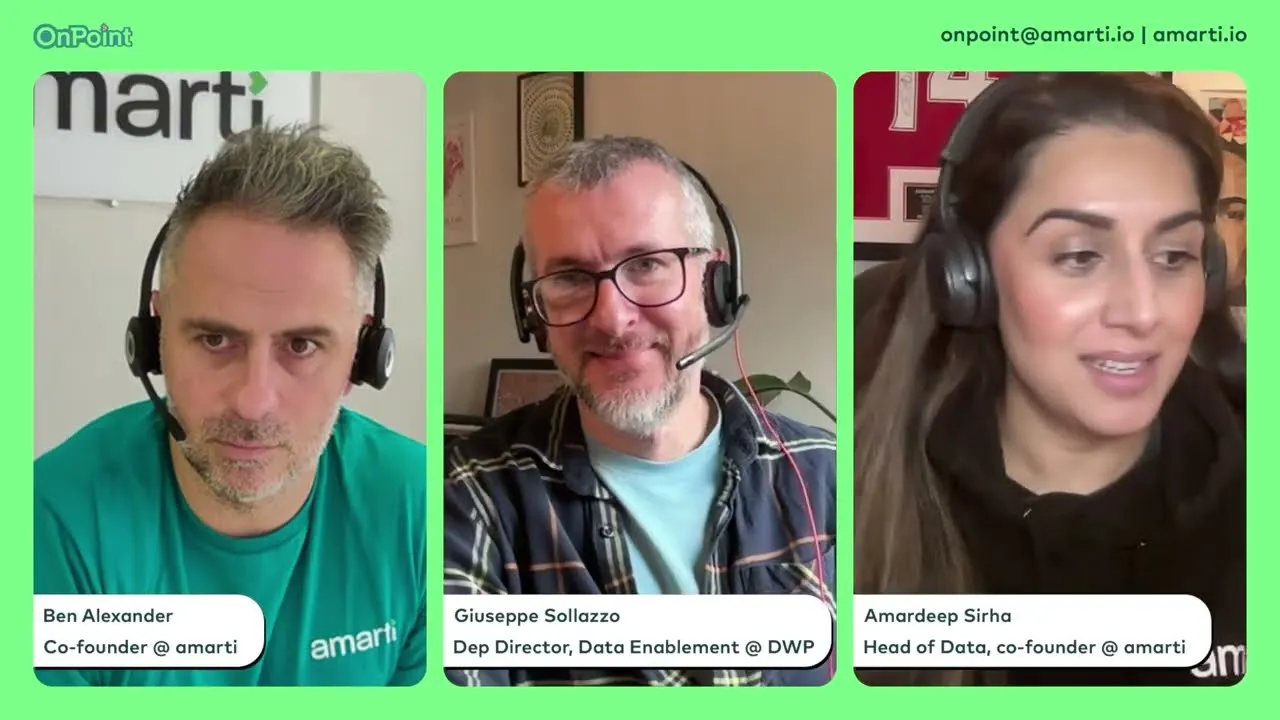
OnPoint S3:E4
Giuseppe Sollazzo (Deputy Director, Head of Data Enablement at DWP Digital)
Watch the full episode on YouTube
On this episode of OnPoint, we’re joined by Giuseppe Sollazzo, Deputy Director and Head of Data Enablement at DWP Digital.
Giuseppe joins us to talk about:
- The importance of knowing your data
- Why data Governance is not your enemy
- Patient-centred care and public accountability
- And much, much more!
🎧 Listen to the show on Apple Podcasts and Spotify.
If you’d like to get in touch with the show, or if you’d like to be a guest on the next season of OnPoint, email us at onpoint@amarti.io.
Read the transcript
Automatically generated from the episode audio and lightly formatted for readability.
Ben Alexander: Giuseppe. Welcome.
Giuseppe Sollazzo: Thank you. Happy to be here.
Ben Alexander: Thanks for coming on. We always start the show, by asking for a brief introduction for the listeners. Would you mind doing that for us?
Giuseppe Sollazzo: Yeah, sure. So, my name is Giuseppe Sollazzo. So I'm currently deputy director for data enablement at the Department for Work and Pensions. So, the civil servant UK government.
Ben Alexander: Amazing. Thank you so much for coming on. Dive straight into it. Giuseppe, how do we ensure data is accessible across large organizations?
Giuseppe Sollazzo: That's a very good question. And when I say.
Ben Alexander: Nice and open.
Giuseppe Sollazzo: And across a large organization, obviously we can go about internally because we are a large organization but also across government. I think there are two elements I like to to raise, and I'll try and be brief. We can, explore them. But one is obviously the know your data aspects. So how do we make sure that we know what data we have, what data we produce, what data quality it is? And what uses are made of that data? And that's very important. It's very technical. And that's part of what my team is working on. The other is obviously making that data useful and usable by others. And, I think there's a lot to be said because, often we we work in an environment where it's difficult to share data. It is perceived to be difficult. You know, there's governance. And I come from a technical background where governance is always seen as a bit of a difficulty. Well, in reality, I'm a big fan of governance. I think governance is there to protect people and governance done well. It's actually fast and clear and creates, you know, boundaries and, assurances for, for people. And the impact of using that data the right way is great. I mean, I'm going to just mention one thing we do across the board that let's say between DWP and HMRC, which is bits of work that I was looking at recently, the payment for bereavement support and that's actually a very important thing, you know, supporting people at the some of the most vulnerable times of their lives. And that's made possible quicker and with a less cumbersome for people by the ability of sharing data across the two departments. So a lot of impact can be achieved by it.
Amardeep Sirha: Can I can I jump in with a question? I just want to go back to the start of what you said, which was know your data. Do you not think it's a bit of a journey to get there for any organization? First? Because I think the amount of organizations I speak to when we work with, if I said, do you know you're there? I think the answers would be varied. But actually they're probably all the same, which is, I'm not sure that I do. So what about if we just go back to that kind of journey first? How do we how do we know? How do we even start to know? Are there?
Giuseppe Sollazzo: That's a good point. And you will find there's a lot of degrees of maturity in that journey. And by the way, our friends are working all sorts of businesses, charities, other private sector startups. You will find varied things. So it's, you know, often in government we say, oh, you're not good at this. And there's a variety of, of levels of maturity across different industries and sectors. I'd say we've gone through different stages and there are different stages of data maturity in an organization. So there is often a first phase in which an organization starts using data. And in that phase, often what you have is they said, yeah, we need to have a data catalog and we create this entity and we start throwing all data sets that we know of into that catalog. And that's actually it's a first step. And it's a good step because it allows people to come to terms with the idea that, we can develop some knowledge, we can share some knowledge about data we have. Is that good enough for the the future purposes, which are discoverability and management of data? Often, not so often. There's a second phase in which usually a more mature organization, that it's understood the problem maybe sometimes with a and a data leader would be, probably moving from an analyst into a more digital organizational person. You will have a situation in which you ask, okay, but how do we embed all this in the business? So it goes from trough stuff into a, into a pot and then try and look through it into actually we can make this a more sustainable process. And actually that transition is the transition we're working on at the moment, which is going from we have thousands of data sets on our data catalog. But the reality is that is a bit untidy, and we can structure that more and work with people in the business to say what data you produce in your day job and, what data are you using? And sometimes these two things are not, about the same. So often you start talking with the rest of the business, and I think you get in that, model of iteration. Yeah. I think it's my personal transition professionally has been to going from the IT analysis into digital thinking and trying to merge these two things.
Amardeep Sirha: And I guess it is working, and I guess it brings up data ownership as well then, doesn't it? It kind of ties them all in. So like who who's going to own the data as well and etc. etc.. Yeah. And it's a, it's a, it's a, it's a journey. Okay. So going from so now let's say we know our data. And I think going into accessibility we kind of like look into that a little bit I think I think for me a lot of the time people use phrases like I don't know which data we have. I can't access the day. I don't know how to access the data or is too complex, is too technical. I need someone technical to give it to me. But that's actually not how it works, is it? You can be in a position where anybody can access to the right data. For example, if it's given correctly.
Giuseppe Sollazzo: Yeah. And once again, it's a journey. So I think some of the work we do I mean, I'm directly involved in about 200 plus data products. And those data products enable things like, well, for payment benefits or one of actually the ones I really I'm, I'm still impressed of. We run the electro registration system on behalf of the local authorities so that buy a lot of data with a lot of potential problems around it. Now, I think, every organization experiences a first phase of a bit of a cottage industry in which there is a centralized model in which there is a data team producing data pipelines, on behalf of the business. And that often produces a situation of you create one data pipeline which serves one purpose, and then you create another data pipeline that creates another purpose. And you don't even question if there is an overlap between the two. So to me, when you talk about accessibility, first, an important approach is to say, are there any common data problems that we're trying to solve? Are we do we have any common data patterns that we should be delivering? And the key questions starts being asked. And that involves, for example, reference data. So are we using some data sets that are constantly, they say constant among different business cases after we talk about addresses, you know, addresses for most businesses will be a reference data set, because we get that from and a Royal Mail or Ordnance Survey. And that is the same for everyone. And that obviously should be available once, probably through an API. And maybe it's, you know, it's an essential service. But then we start asking questions around what are the, derivative products? And are we producing derivative products that are themselves a reference data service? Or maybe, they need to be, common entities and all this is very contextual. And I'm going back to the addresses for us. Address. And address is a reference point. But if you think about Royal Mail or a local authority, well, address might be an entity data in itself because they create those entities. So what is reference. What is it's a master data. And what is regular data changes across different sides of the same business. And I think that's a fascinating aspect of making data accessible.
Amardeep Sirha: Yeah. And I also think by defining that earlier on, which is reference, dairy also helps you model the data correctly as well, doesn't it? Because then then I guess you can have you know what your primary keys are, your secondary keys. And you can go from there because you could. But I think it begs the bigger question as well. I'm going to I'm just just playing devil's Object. Yeah, a little bit. I think like. It's a big assumption to think that all organizations look holistically. What I find is that each organization has a project here, a project there, a project here, and everybody just runs off and does what they they want, which goes back to your initial point where you end up with loads of different data pipelines, and ingestion and, and it becomes into a bit of a spaghetti junction because actually they're not thinking, okay, so I need to, visualize this data over here. I need to maybe model it a little bit better and have it visualized in some way. Let me just see, does anybody else need is anybody else already done it. Has anybody else already done it. Because I think the other thing that ends up coming into it is people run to decentralize their data. When they're not ready for it to be decentralized, then what you end up with is lots of centralized parts of that. Actually, it becomes it becomes even more messier. So how would you, how would you tackle some, like, normal business issues that get in the way of being a little bit holistic and actually doing it the right way?
Giuseppe Sollazzo: So my call to arms and this is usually it's actually two words. The first is multidisciplinary and the second is iterative. Yeah. And that's I think what I've learned moving from, you know, being an IT person to a data person and adopting digital ways of working, it's the fact that, first of all, to do data. Well, you need to have multiple people around the table. So it's not just data engineers, not just data scientists, not just policy people, not just digital people. It's all these people around the table trying to understand what is the right thing. And iterative, I think, is, is the thing that qualifies, worked on well because I'm pretty sure, especially in a context like, well, the one we work in, you know, government is obviously it's about, different political parties or sometimes different, you know, currents within the same party taking power and each one of these changes produces changes in policy, sometimes subtle changes in policy, sometimes revolutionary change in policy. So the key element of a of any data work done well to me is, you know, the, the test of any data work there. Well, is how fast can we adapt to those changes in policy. And once again, you were making that interesting point around centralization versus decentralization. I think there's never going to be a final answer. What's the best model? The best model evolves. And sometimes, you know, things start, as you say, in the business and, you know, the cottage industry happens. Then it gets brought centrally. But bringing things centrally sometimes create bottlenecks. So there is then a drive to say, well, actually we should be essentially we're decentralizing but with increased maturity because that move has already created that maturity and an understanding of what the common problems are. So what we ended up now with trying to implement a bespoke model for for our data, and that actually comes from having created that central team about ten years ago, then evolving it, realizing what the bottlenecks are, and now saying, well, actually, the organization isn't mature enough in its ability to deal with data, but we still need the center to set the standards and exactly to pick up on those signals that you were mentioning. So the duplication of data and you need to have common entities.
Amardeep Sirha: And I think also, to I was just going to pick up on something you said also when you have like a little bit of a centralized part as well, it can ensure governance as well. So like they can, they can enforce the governance through the tooling. And I don't want to I don't like to say certain phrases because people get really the audience can sometimes get a little bit excitable and send me DMs that I'm not prepared for, but I'm going to say I'm just good, I'm good. Just going to say like dit, a mesh style, like it does work. I think if you if you can, if you can implement something like that, it works for your organization. I think that's the other thing as well. Is it right for the organization? I always think like 15 years ago when, this is going to be really controversial when agile became popular. I'm just going to say that I'm a big I'm a big advocate of agile, and I'm a big advocate for the right methodology, for the right organization. That's all I want to say. But, when it became popular, everybody rushed to implement scrum teams, for example. And that was it. It's going to be scrum teams. And they didn't actually for a lot of organizations, actually, it didn't work. Some organizations were doing a sort of hybrid waterfall agile pre popular agile anyway. And it was working actually. And I think that's how people need to look at technology as well as what is right for the organization. Don't jump on. The latest trend is your data governance. Do you trust your data? Do you know what day you have? Can you access your data? There's some key principles there, and I think if you can go with that mind frame, you'll start to do the right things anyway for your organization.
Giuseppe Sollazzo: And also, once again, I want to highlight governance as a bad name. But governance is about doing things right.
Amardeep Sirha: 100%.
Giuseppe Sollazzo: Not about doing things slowly. And yeah, yeah, I'm going to I keep in this example from my work in the NHS where, you know, my, my job in the NHS was basically running an AI accelerator for the NHS and it meant engaging with NHS trusts. So we did about, I think 20 plus projects and the variety of duration of the governance process was remarkable because the fastest was three weeks, so all of the sign off achieved in three weeks, and the slowest was 17 months for three months projects. So wow. And that that variance tells you, I think, more about the maturity of the organization than anything else. The maturity is not about, you know, is a good or a bad thing. It's just once again, the journey. And just to reveal who was the three weeks NHS resolution, which is an organization that deals with very serious cases of, medical complaints. You know, we actually we're looking specifically at maternity, complaints and obviously an organization that has that in its DNA will not be scared about any new use of data. You know, the people do data protection and, data assurance will be ready to, to assess that. While on the other end of the spectrum, organizations that maybe have never dealt with that, maybe in this case it was a research institution, which, however, was not connected to a hospital, and therefore they had a very different approach to to medical ethics, to medical, assurance. They were scared. And the, the people on the ground, had not reached that level of maturity. So before, you know, what happens is that there is, you know, there's this request for a simple access to data request, which then gets sent to someone's manager into someone's manager, the system manager, before you know, it reached the chief executive and obviously the chief executive diary you usually in NHS trust is massive and within certain universities massive as well. And that's what causes the delay. So to me yeah big lesson was hold downs with the organization. Make them get into that journey of data maturity. And that is what actually unlocks governance. It's not a about governance.
Amardeep Sirha: No. And I also think that there's there's just a little bit of an education piece because I think just us as humans, when we think of governance, we think of bureaucracy and we think of process and policy and data governance is is not that actually is actually liberating and frees you to use your data more confidently and, you know, make better decisions. And especially around, NHS and stuff like that is patient centered care, right? So it's doing the best for the patient and for, for the customers it serves. And that's all of us essentially. So I, I have a these guys always make fun of me in the office. Actually I you're always banging about data governance. And I was like, once you kind of get that correct, you can actually let people freely do what they want with the data because you've embedded the governance in there. They're not you. Also you you give them guardrails to also fail if they need to fail and they can fail faster. And actually, once you free people, they're not scared of data anymore. And your journey again, the maturity happens and the journey moves a lot smoother and a lot faster, which I think is important, especially in large organizations, whether they're the public or private, I don't think really matters. But for me, thinking about the NHS and patient centered care and all the things we hear in the news about the NHS as well like that, they're trying to do a fabulous service, they're trying to do the best that they can possibly do with limited resources. So let's help them get to that place is even more important.
Giuseppe Sollazzo: You're alluding to a very important topic, which is engagement with the public. And actually, I think, you know, as this, ability to talk on the podcast proves, I felt very supported by DWP in that, you know, let's engage with the public. Let's talk about the stuff that we're doing, because that actually creates that mutual trust. And I think it's very important for us in the public sector in general. I mean, not not just central government, but all public services is to keep that conversation going and create that mutual trust, because it's that way that we can transform the way we run public services.
Amardeep Sirha: 100%, 100%. Because I also know, like the phrase public accountability comes up a lot when you're talking about public sector organizations. And I think that's important as well. And I just want to touch on a point that you mentioned, I think people often forget. So NHS houses, any, any public sector, a wealth of data and then they'll have their own initial, I'm sorry, their own internal initiatives that they want to drive, but then they're pulled and pushed by council and government and what initiatives they're trying to push as well. So they're trying to juggle lots of plate plates whilst always thinking about patients. They're all always thinking about their customers who are patients ultimately. And I think that when you're trying to go on such a transformation and when you're going on a journey that's forgotten, that's really hard. And and I do feel a lot sometimes for, portfolio managers or directors in the NHS, whatever that kind of level that they are thinking. Right. I really need to drive this initiative because it's really going to help this particular trust. But I'm being pulled in this direction and then I've got limited resources in terms of finance, in terms of people, I understand it.
Giuseppe Sollazzo: I mean, obviously I wouldn't be in NHS now for almost four years, so I well, I can't possibly comment on I think I'd have to say and I think it applies to all of us working in the public sector. That is part of the way the country is run at this, right? You know, there is this ongoing conversation that happens between us as the to say the, the administration, like the the permanent people, the civil service or the public servants, together with the public and the politicians. So the public elected the politicians, and it is our duty and to support them, but also to to challenge them whenever it's needed. And I think one thing I've experienced, I have, you know, I've worked under probably now seven different governments. I mean, some some within the same parties, but basically I've had the experience of engaging with with that. I think, we, we have a solid system that allows that scrutiny and challenge to, to continue. And, and that is two ways. I mean, we are challenged by the politicians to do a job better, maybe with fewer resources. And that obviously, in a way it's difficult when obviously, as we know, we need to to have financial, control of that one thing. But it's also what unleashes creativity and the ability to see innovation.
Amardeep Sirha: Maybe that's not.
Giuseppe Sollazzo: The way of solving the same problem. And so, yeah, that's what, you know, in a way, that's what brought me to work in the public sector. I find that challenge exciting. And the idea that we have to, you know, as a taxpayer, myself as we all are good value for money is a good thing to aspire to.
Amardeep Sirha: 100%.
Giuseppe Sollazzo: One that I'm sort of happy working in this environment. Although, yeah, people might say, oh, but it's frustrating, it is slow and there's politics. It's just part of how to do things. Well, and.
Amardeep Sirha: And not and also that, that same stuff happens in private organizations. There's actually more politics in the private organizations anyway. So, I mean, that's happening everywhere. And I think you're right. I think, resource constrained resources breeds innovation. Like, it just breeds it because you have to you have to figure it. And so you have to get to a solution. So you're giving your you're given your parameters and you get some good minds in the room. And they're going to go to town with solutions that perhaps no one's ever thought of before. And I think that's really great as well. But then you're wanting to ask the question, sorry.
Ben Alexander: I well, I just I'll just really, listen, intrigued. They really because, Giuseppe and I met recently and follow a lot of his, I guess, post on LinkedIn, and it's pretty remarkable, really. We took about seven different governments and 200 or data products. And you. I can't bring you down. You wouldn't. You're all over the country. You've been across Europe. You're speaking at so many different events at the moment. And I just find it so interested. And really the point that you want to speak to, I guess the customers and consumers and the service you do for the government, I find really, really refreshing. So thank you again for coming on. But again, I'm quite I'm quite interested in because you at so many events because you took it. What what's the big trend you're finding at the moment? What are you enjoying speaking about at the moment. You know, kind of give you a bit of a platform because we give it a so much info there.
Giuseppe Sollazzo: That's a good point. I mean, honestly, so a lot of my traveling around the country, I have people in seven locations, and I think a lot of good work happens when you meet people face to face. I mean, we we should get into the whole being in an office thing, but yeah, it is actually important to see people face to face. And I'm sort of enjoying that. That's what the meeting. And it's also I think it's important. That's the other thing I do enjoy of the fact that we are such a distributed organization is the fact that people live in different areas of the country, will also experience different challenges in their lives. So especially in a situation like, you know, DWP or many other departments having to serve the public, having that distribution is actually really, really good and really refreshing for meeting a winner. When I meet my colleagues in Newcastle or in Blackpool or in Manchester, I mean, they're all actually having different, experiences in their life. And that I think it adds to the ability of, of us, of the civil service to actually cope with different situations in life. So that's, I think one element and the other, obviously, there's a lot of talking about the AI. And my previous job actually was about AI and I did say when I move jobs, you know, in this job, I'm not going to talk about AI, but in fact, actually, that's up and up and a lot because I think good I, I always say, I used to say this in my previous job quite a lot. Good AI is basically considering this as the new tool. It's a tool, as many other tools are. And as with every tool, we need to learn how to use it, to measure it, to evaluate it, and to actually I need to actually, plug for my colleague Sean Thomas, who's the chief data officer at the department businesses. Right. I know if you've ever spoken to her, but she was saying this actually, they are doing a lot of this stuff. But every project, Aaron has an evaluation, framework around it, because what we want to know is when it works, but also when it doesn't work. And the more we open about it, the more we can get the good stuff. And to me, as an inside data person, could, I mean, saving the data. And that's part of of the work we're trying to do. I'm working quite closely with our deputy chief. There's all this, on establishing data quality and data quality. It's not just having a tool that tells you we know if your data is wrong, but it's about a culture, is about making sure that those data pipelines are built the right way. The right measurable way from the outset. And once again, we go back to not your data. You can only measure if you know it. It's there that we're trying to basically work with the business on this sort of pipelines and not a data pipeline. They are business pipelines. It's all about how we run the operation. In a way that done, you know, make sure that the data is good and what the data is good is contextual. Often it depends on the use you have going to make up that data.
Ben Alexander: Nice. It's just that it's it like I say, it's it's, it's it's super interesting. It's great for you to come in and explain it how in terms of the government, in the government sector, you hear a lot about the investment into AI. Now, how do you how do you think this is going to evolve moving forward? What's the what's maybe the challenges that you see?
Giuseppe Sollazzo: I mean, I think once again it's AI done. Well what does AI done. Well I mean it first of all, I think it means, first of all, AI that improve some process. And that might be an internal process. It might be, I think, you know, engage with the public. Obviously, there's a lot of talking around at the moment. Airlines are you know, helping create this new conversational, interfaces. And, you know, once again, can we measure how they are impacting actually, interestingly, again, some published this incredibly good report around the business benefit of using copilot, which is actually quite a, you know, I would say measure the report. And we all learned from it. I think there is investment in AI. It's a good thing. It's it's good that, the government explores this new technology because it's a lot of it is new, in private businesses, I'm sure, are doing the same. But for us, the thing that AI is doing is actually allowing a lot of, senior civil servants to get around the table and talk about what do we see, this new technology being able to to run public service in a different way. We transforming a business line are we making a data pipeline faster, or are we actually rethinking how we we engage with the public or among themselves? And I think we've all following guidelines. I mean, DWP has a its own AI innovation lab. I'm, I'm on the steering board, but I'm not running it, so I can definitely, get you in touch with my colleagues to do that. And I think there's a lot of trialing of ideas. And the good thing is that we accepting and not all of all, not all those ideas will work ultimately, but that teaching us a lot about how the public engages with us and about our colleagues work. So to me, it's a great opportunity. I did see that opportunity when I was in the NHS, and I would say of the 20 projects we were on back then, not all of those have gone into production, and that's a good thing. It's good to see that we basically been able to say which ones are actually producing benefits. And often, you know, when I go around the country, those are the questions that come into place. Where have you seen the biggest advantage? Well, I remember when I was in the NHS, one of the biggest things was we did this project that, detects Parkinson's disease in brain scans. And that's a research question. It's not like an operational question, but that's been able to massively speed up the work of humans because, you know, image detection is is a skill that AI does better than humans. But there are other situations where the advantage is not that clear cut. We're actually having people on the ground is more important. And to me, that is the big advantage of AI is like providing people with, better, you know, better knowledge, augmenting their knowledge about the person they have in front of them. And, and that is that how we can transform really operations. But yeah, I mean, I'd say I'm looking forward to see what happens. I'm really looking forward to supporting that with good data, because I think good data is the basis of having not just good AI, but good whatever mechanism you use in terms of analysis, in terms of operations. So to me, good data is is the key element.
Ben Alexander: Absolutely. Giuseppe, I think that's a great time to, to wrap up, I think, you you do a great job. It's a, it's a, a large organization working across government, working with different teams all over the country. I know you're very active, in giving talks and educating and and sharing knowledge from the government. So again, thank you so much for that. We often have people who listen to the podcast who, like to, to reach out and ask questions. Are you fairly open to that? Oh, absolutely.
Giuseppe Sollazzo: Absolutely. I want them in my direction.
Ben Alexander: Yeah. Fantastic. That'd be that'd be great. So yeah. Thank you very much. Really appreciate your time. Come on. I know you busy, man. Really appreciate it. And look forward to meeting in person soon.
Giuseppe Sollazzo: Brilliant. Thank you for having me.
Amardeep Sirha: Thank you.