
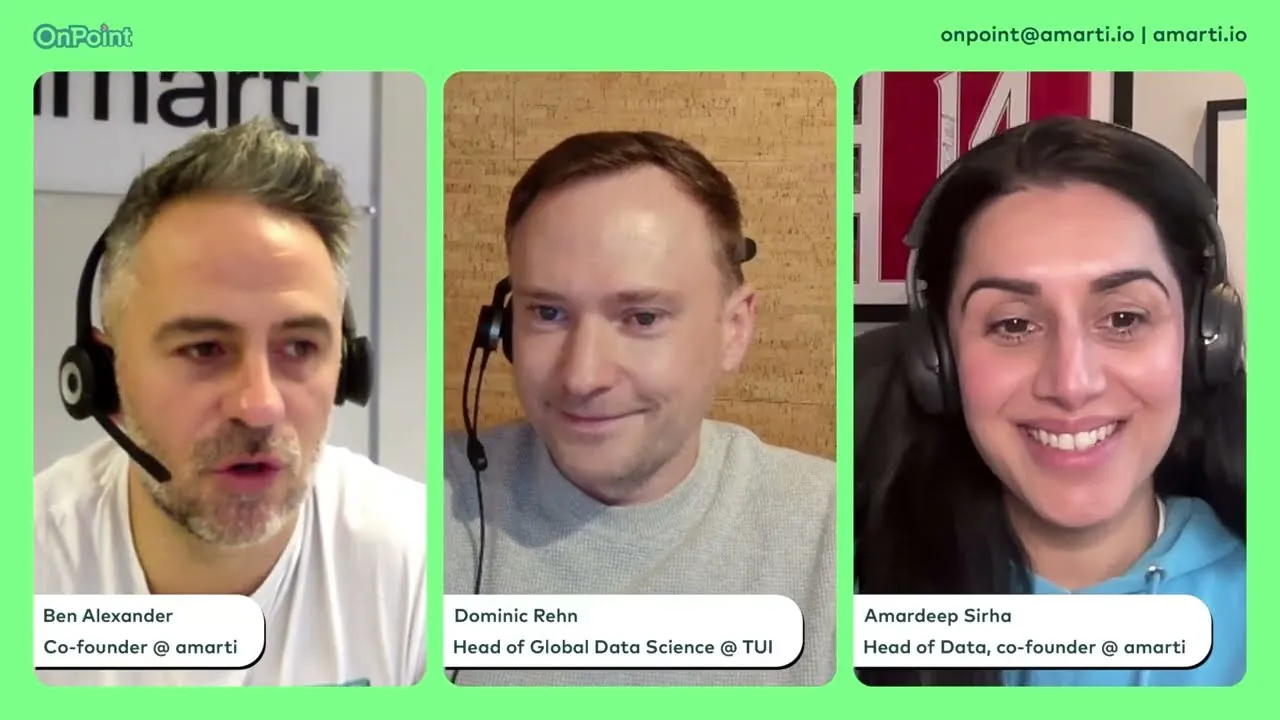
OnPoint S3:E5
Dominic Rehn (Head of Global Data Science – Customer Marketing & e-Com at TUI)
Watch the full episode on YouTube
This week, Ben and Am are joined by Dominic Rehn, Head of Global Data Science at TUI.
Dominic joins us to talk about:
- How we define customers
- Who owns your data
- And how AI has blurred data ownership lines
🎧 Listen to the show on Apple Podcasts and Spotify.
If you’d like to get in touch with the show, or if you’d like to be a guest on the next season of OnPoint, email us at onpoint@amarti.io.
Read the transcript
Automatically generated from the episode audio and lightly formatted for readability.
On this episode of On Point, we're joined by Dominic Rehn, Head of Global Data Science at TUI. Dominic joins us to talk about how we define customers, who owns your data, and how AI has blurred data ownership lines. If you'd like to get in touch with the show, or you'd like to be a guest on the next season of On Point, email us at onpoint@amarti.io. Now, on with the show. Dominic, welcome to the show. Thank you. Thanks for having me. Thank you for coming on. Could you please start off by introducing yourself to the many listeners of On Point? Sure. Yeah. So I am the Head of Customer Data Science and AI at TUI Group. And I've been working for TUI now for about three and a half years. My team is predominantly responsible for delivering personalization across the customer area. as well as, obviously, in the most recent couple of years, focusing a lot on the AI side and how we can deliver kind of customer-facing AI solutions to drive marketing, customer service, digital kind of transformation as well, and how we can better improve our experience for our customers.
Fantastic. Thank you so much for coming on. A topic today, and we often go off topic. We do. And I'm sure we will. But something that we hear a lot of at the moment in every conversation we have with our customers is something around data ownership. So it's something we wanted to start on, if that's okay with you, and to, like I say, we'll, I'm sure we'll elaborate from there. Would you say that data ownership is mature in TUI?
It's a really good question that made me, makes me wonder what mature looks like in a way, to be, to be honest. And especially now, more than ever, I think it's kind of a shifting, shifting area. I think on paper, TUI is pretty mature in data ownership. They took pretty much before I started. So I joined just after COVID. So, you know, a pretty lively time in general. But TUI, they'd taken the opportunity of COVID, really, to kind of transform how they worked with a lot of their systems and their data at that point. So they started, they took that opportunity to move to the cloud. So they moved from, obviously, you can imagine TUI's been built up over many years, lots of company acquisitions, loads of legacy systems in there, and a very complex base of data, not just customer data, but also commercial data and operational data. So they made a big change there to move into the cloud.
And at the same time, obviously, organizationally, we adjusted how they were working into domains. So particularly in the IT area, having a customer domain who's then responsible for customer data, ownership around customer data, same with commercial and sourcing and various areas of the business. So I think on paper, they've done all the right things to kind of set themselves up. And start making that migration from, yeah, a really disparate, challenging legacy system into a much more modern stack and an organization that is more product focused and using that kind of product data as a product approach. I think the reality on the ground is, if you ask people who are working with the data, they still struggle with ownership challenges around the company.
You know, data quality is still, like many, many, or I think nearly every big company and probably some small ones as well, really a challenge at times. Because governance is always continues to be a challenge and finding the right person, especially in a big company, you end up so far away from the source of the data that even with the right things in place, I think it's quite hard to maintain that kind of ownership all the way through because you're not interfacing with those people. So having – so it's a journey like anywhere. It's probably a never-ending journey.
So I think mature, yes. But, you know, where everyone wants it to be, absolutely not and a long way to go. And it's a moving business. You know, everything is growing all the time and, you know, everything is changing all the time. So, you know, even when you sort one area, there's kind of, you know, two new areas that need to be added to the backlog of how that would work. And I think then the difference now with AI, I think it's kind of blurring some of those edges that you had in the past. So in the past, not that it's an easy job to say, okay, this domain is customer and you have customer because, you know, you then have to define what's customer data and what's not. And that's not an easy job in itself. But I think as we go into this new world and we're realizing that we have another step of data to kind of manage and structure and own, I think that's setting us up another phase of kind of transformation into that maturity.
So I think at one point we probably felt we were mature and then I think we're going into, okay, we're now, you know, back into a challenging area again and having to redefine that ownership and who's responsible for those kind of areas. Yeah, I agree, Dominic. And also I don't think other organizations should be scared of the fact that actually, you're right, all organizations are struggling some way with data ownership. And I think you're right, going into the AI, when data sets, for example, are assembled from multiple sources as well, open data, user-generated content, whatever it looks like, who technically owns that composite data set. And I think it's really, it's actually becoming more difficult now.
And also when you say you own the data, what are the metrics of saying you own data as well? And what if like multiple sources or multiple domains or areas own the data, they co-own the data? Yeah. I think it's not as simple as what some people think data ownership should be. No, really not. No, and it gets really complex. Yes. Yeah. I mean, even now, you know, I'm having conversations this week and around, we have like clear domains on commercial and customer. And that's an example in the past where you could kind of broadly split that quite nicely. You've got, you know, we've got our yield and pricing models and offers and things like that. And then we've got customer data and what the customer and the marketing data. And you could kind of say that that's quite in the past. And we were quite set, you know, we were working quite separately in the past.
And, you know, we would have the occasional project where we need to talk to each other and get something from each other, but generally not really together. But now when we're looking at what's going on and what we're trying to do around personalization in that space, I mean, ultimately, they are now completely combined in the, you know, if we're talking about offers, what's the right offer for a customer? And where's that offer coming from? Well, you need the customer data into the commercial team and you need the commercial team data into the customer data. And that blurring of the lines means that we have to find kind of new, constantly find new ways of working and trying to collaborate together without, obviously, you can't just go through an organizational shift each time a project comes up. So, it's kind of, it's just a constantly moving thing. And you also, a lot of the time with AI, we're doing stuff for the first time now.
And no one really knows what the patterns are that we're supposed to be following and how we're working. So, everything's kind of new, which makes things challenging just because of that. So, you're planning things out and stuff. Agreed. And I guess, especially in your sort of data science area where you start thinking about ethics or privacy or regulation, you start thinking, right, well, who's accountable for any biases or harms arising from the models that we're creating? Is it the model owner? Is it the data owner? Is it both? And I suppose as we go more and more into the AI world and it becomes more and more of our day-to-day business and in personal life, we have to account for biases or harms arising from models that are being created, especially self-optimizing models as well. And I always think to myself, will there be a shift and even further reluctance to own data in case something then happens off the back of that?
And that's quite an interesting one as well. I absolutely agree on that. I think that as the risks kind of increase, you always see that people go, okay, well, that's not my, you know, I didn't do that bit. Or, you know, and you start to, it does get really challenging. And I guess as well, like in that part as well, you know, if you consider like in AI models or data science models are essentially data themselves. And then again, it's that other layer of saying, well, who, you know, the data scientists would say, well, I built the model and, you know, okay, I monitored this and set up this to check here, but I don't control the data. You know, I don't control the data in data. You know, what you get in is what you get out. And yeah, and it's going to be very hard to get people to take responsibility for things where they don't have transparency and visibility of what's actually happening.
I absolutely agree. Yeah. Especially with like model drift or retraining, like with new data, it does, like, you're right, it blurs the lines a lot. So how do we, how do we technically record those changes and who owns it is very, it'll be interesting actually in a few years, not even a few years, probably in a year's time to see or speak to people where they have got self-optimizing models. And where data ownership stands in that now there and how different teams become involved with the ownership. Because I think the vast majority of organizations that we speak to, the vast majority, if not all, they have a problem with data ownership. And I think it's probably going to get worse first. Yeah. And then there's going to sort of, then when people start to think about governance in a little bit more, well, it becomes a little bit more critical for the organization. Then they'll start thinking, right, how do we get some data ownership and do it properly?
I think it, I think actually the AI might be a catalyst for sorting out the governance. Yeah, I think the, I'd agree. And I think I see a lot around this and I know there's obviously a lot, you know, people who are in governance today will be kind of screaming, you know, from the top of their lungs, essentially around like, you know, you have to have this in place before you can do these. The challenge is, as always with these things, something comes along like AI has a completely revolutionized it. But the governance is going to be dragged along, you know, it's going to be the last thought on anyone's mind because everyone wants to focus on how do we get this thing out and how do we make a change up here? And it's only once you kind of get to that point and you've proved that everything's falling apart or really hard to do that you then go, okay, like, why are we having that problem?
And then you go back to governance. And I know the people that, like I said, the people in governance will be sitting there going, so I've told you this all along that you need to have this. This is also Amadeek. This is her favorite word at the moment, governance. And it actually comes up on every single podcast, doesn't it, Am? Yeah, it really does. And I think it's more because you can embed governance in your tooling and you can embed ownership also into, you know, do you put it into your data contracts and schemas rather than just relying on policy? Now, I always think with, I think when people hear the word governance, and I've said this loads of times, they think policy and bureaucracy and the connotations attached to the word governance. But it's actually not that. And it's going to make everybody's life a little bit easier, especially if it's embedded in your tooling.
And I think there is, you can also embed that ownership in your data contracts as well. And you can do it so it's not just a reliance on policy. And also policy becomes, like any document, it's out of date the moment you write it, right? And expecting people to read it, I just think, they're not going to. Let's just be honest. No one's going to read it. And also the way things are read and interpreted can be very different as well. And then as soon as a new CTO comes along or a new director of something comes along, we then go into that same problem of they might rewrite it. You know, so I think, I just think that data ownership, if it's sorted to the best of its ability in an organization, along with governance, actually, you can really do wonders with your data. Because no one's scared of the data anymore either, are they?
No, you've got this area now. I mean, I think coming back to your point before, you've got absolutely making it easy is the most critical thing. So we talk about like the data lineage and where you've got that now. And, you know, when I was, it's not even that long ago, but when I was doing, you know, data engineering in the past and data lineage was an absolute nightmare. Oh, yeah. And you basically kind of just gave up at some point. You'd say, okay, you can, you can map maybe between these three things here and then you've got a massive black hole. And then maybe you can fill it in somewhere at the end. And now the tooling's so much better that you can track it all the way through. And that makes it a million times better for everyone. And I think AI obviously will bring even more benefits in that space in terms of around tracking through code and stuff like that.
So I think there's loads of opportunities there. I agree. And I think with, let's call it the surge of AI. I don't know what we want to call it. It's been around for a long time, but it's popular now. There's so many tools being built, actually, that sits on top of unstructured data. It sits on top of messy data.
And it helps you pull out your lineage. It helps you understand your data better. And then you can decide, is that tool the right thing to just go forward and I don't actually need to sort my data? Or actually, do I want to invest a little bit and let's sort out the data now that we understand what's wrong with it? Because I also think as well, in the last five to 10 years, the way people work has changed a lot. People don't, well, some people do, not everyone. I'm generalizing a little bit. But a lot of people don't stay in their role for 10, 15, 20 years anymore. So the churn that's going in and out of organizations is two to three years, sometimes five, and people move on. So that means the wealth of knowledge then goes. So if you haven't got your data lineage and you don't understand your data, you never will because the people working with it are moving a lot as well.
And I think about that a lot when if we engage with a client, a lot of the time we're like, okay, who's the specialist on just even this one data model? Oh, yeah, no, they left 10 years ago. Nobody understands that data model. We know it works. Yeah. And we get the insights that we need. And please don't annoy the finance team by messing it up. But it's not, you know, it doesn't work because we don't know how, who understands it. Yeah. And I think that should be taken into account, churn of an organization when thinking, do we invest in any area of technology to sort something out? Because I don't think people really do documentation too tough anymore either. No, no, no. I mean, documentation has always been a struggle. A struggle is the nice way of putting it. But, yeah, I mean, but again, I think, and I mean, whether it still gets done, I suppose.
I mean, I had a conversation, it's probably about two years ago now, and we were kind of going through some of this stuff when Gen2AR just kind of exploded, really. And we were kind of looking at it, and we were kind of talking about, I think the data scientists and some of the engineers were starting to use it to kind of add comments to their code.
And then we had a kind of, I remember having a conversation with another head of who was saying, actually, is this a kind of pointless exercise completely now? Because do you even need comments in the code? We just, you know, essentially, when you need to know what it's doing, you can just go and ask what it's doing. Is this in itself kind of a challenge? And, you know, it's just a small thing, but you started to think, actually, this is going to kind of fundamentally change what we have to do and how we do it. And especially now, as code is kind of more and more generated by the models themselves, how, what we need to do and what we need to understand about that at the point, you know, in general, having that documented somewhere is probably less important in a way. Although I guess we probably also use it as an excuse not to do the documentation that we never did in the first place anyway.
Yeah. When I think about data lineage, I think everybody's moved forward because of AI in how we used to do things. And when I think about data lineage, there's lots of data lineage tools now out there as well. And I wonder, can it be, can they always be configured to reflect business level ownership, not just technical dependencies? Because something with ownership and data ownership, it's really interesting, isn't it? Because, and if we take customer, the age old thing of every organization has 15 definitions of customer. Yeah. And I get that because it's what customer means to them in their context of their role in their organization. So I understand that. Yeah. But I'm going to assume you guys own customer. Yes. Okay. I'll leave it there. Okay. So if one person owns customer, it's not a small task. And this is just one piece of data. This is just one field. It's not a small task to then put the parameters around the definition of customer because you have to take into account customer from everyone's perspective.
Right. Yeah. But then that kind of activity is big. It's a big activity. It's a long activity. It involves a lot of people, which is why I think people don't focus on data ownership. How do you overcome or add in what customer means?
It's a very pertinent question right now because we're having a lot of these discussions at the moment. And as you say, we have numerous ways to identify our customer identifiers. We obviously map those together in certain ways. We have exactly what you just said, which is, you know, to the I mean, to the digital team working on the website, their version of a customer. And because they have, you know, however many million visitors a year is a completely different view of that than the CRM team who are looking at those with an email and a permission to contact, for example. And the same for customer service who are talking about they have a booking and they've got something, something there. And then we have the analytics teams who are trying to map all of those things together to answer all the various questions that are going on around the business. And so they have their own customer or another customer ID that stitches some of these together.
And we are in a place where we're kind of doing that exact work at the moment. And because there's so many people involved, it's so slow to get things through because there's always something you haven't thought about or there's always someone there that has a different view of what we're trying to do. So one of the things that we've tried to do, it doesn't solve all the problems, but we've gone to this. We're moving towards, we're pretty much there in terms of a kind of account view of our customer, which enables us to do certainly more of the customer from a booking and CRM management. So all of our bookings now have an account. And that actually makes it hugely easier than it was before, because we know that we have to have an email address for the account.
And we can then obviously stitch various IDs to that account in terms of that. It doesn't solve a number of different problems that we've got around the business in terms of, you know, firstly, what is a customer? Are we treating visitors as customers or are they just, are they not? Is it someone who's made a booking? Well, then you've got the people who've got an account who've never made a booking with us. You've got all kinds of definitions around that. But what we're trying to do, I try to drive from my side, just simplicity as much as possible and try and think about that outcome on the business side, which does get muddled up because it's significantly, you know, by myself and the people in the business areas, because there's always some edge cases or there's something going on that's hard. So we're trying to drive this kind of simpler view of it and focus less on everything and worry about what's actually going to drive the value in each of the areas that we've got.
And some of those are, I think at times, I feel lucky working in predominantly in marketing is our area more than, say, customer service. So, you know, they have their areas and things like that. But in marketing, I always kind of try and, you know, say we're just marketing, right? If we get it wrong slightly, sometimes it's not the end of the world. If we miss a customer here or there, we're talking about millions of different actions or billions of different actions that are going on around TUI in a single year. We're going to get some wrong regardless. And it's not a major issue. Obviously, that's completely different for the customer in the customer service where you have to have this really strict and strong connection to the account. You need to know the account. You need to know the customer data is absolutely correct because, you know, when you're contacting them about booking or when they're contacting you, you need to have all the right information.
And so the level of kind of importance around that governance of the customer is also really important. And I think it splits into personas, doesn't it? And this is the whole conversation of customer because you're right. I was just thinking about what you just said. A customer who has an account, but that's never booked or a customer that's a visitor has visited the site, but hasn't followed through on the journey or a customer that has booked. And then you've got the customer that repeatedly books. So actually, you could end up with lots of different customers, but they're named different, right? Yes. Yeah, absolutely. I mean, even the use of customer in itself is kind of a hard – you already set out certain things. And we've got the other challenge actually in TUI, which is you've got the customer, which is really essentially in that – in one example is the lead booker, the person that actually makes the booking.
But then obviously, you've got other passengers around it. You've got – and coming from the commercial side particularly, they talk about – we talk about packs, passengers in commercial. So the number of essentially booked seats on a flight, for example, or whatever. In the hotels world where we have our hotel brands, obviously, they're talking about rooms and nights. That's right. So you've got these kind of things. And that happens – this confusion happens across the board. We might say we've got 5 million customers on – CRM would say they've got 5 million customers or something like that on their email base. That would be like emails that they have permission to contact. In fact, you've got – and then you've got the number of visitors. The websites might say we've got 100 million visitors or customers to them. And commercial would say, well, we've done 20 million packs this year. And hotels would say they've done – I don't know.
I'm making up numbers, obviously. Yeah, no, but I know it makes sense. 5 million nights in their hotels. And all of those will use customer as a phrase at some point.
Sorry, go on. No, no. So I was just going to say, as you go up, especially when you're doing reporting and KPIs, and you see this strategic KPIs go forward and you've got targets. And you have these conversations where you see a slide and everyone's having a conversation. What do they mean by customer? We want to increase our customer base or something. And you're like, what's the customer there? And all of that is just – I mean, it takes years even just to figure it out. 100%. And we're talking about one field right now. Yes. One definition here. One definition here. And it takes me back to when I first started in technology. I came in as a – I changed my career. I came in as a junior BA. And I was being taught by an incredible, incredible, incredible human being how to write a user story.
And it was very – as a user, I want to. So that, right? And we were doing some practicing. And she was going, which user? And I was like, the user? She was like, which one? And I was like, the customer? She was like, which customer? And every time I think about data ownership now, I go back to them really early days of my career where I understand now why she was like, you need to be so clear-cut about which user you're talking about. Because I was – we was building something internally for the organization. And I was saying user. And she was saying they use user for the customer. So who are you talking about? And I was like, the employee. And she was like, which employee? And I think about it all the time because it makes so much sense. It was very traumatic for me. But it's definitely the reason why I love ownership and governance now because I understand it.
And also, I've been in an organization where it was a loyalty program. And I sat in data in marketing. And they just wanted to send a personalized email. Sounds really easy. Sounds really easy. Why can't I say, hi, Amadeep. Welcome to this program. The biggest problem was they couldn't identify which version of me they needed, which version of the customer they needed. And what they wanted is a repeat purchaser, a repeat customer. Yeah. And they couldn't identify that in the data. So people that had maybe even looked at the website were getting the emails. So I really understand the difficulty. And we're talking about one, again, we're talking about one field here. We're not talking about the amount of different definitions that need to be done. So I really, really appreciate that. And I think just for anyone listening, like, everybody is going through this and they have been going through. This is not a new problem.
This is a problem that's been there all the time, but I think is now coming back to the surface because of the introduction of AI and everybody wanting to do something in AI. Yeah. And I think just quickly on that, I think it goes back to what we were saying at the beginning about everyone, you know, not being scared. Because I think a lot of the time now what we see is on the opposite is when we're speaking to businesses about delivering projects, it's where budget sits. It's everything's very tight around budget right now. And, you know, does it fall with technology? Does it fall with marketing? We're in the business. And that's been a big challenge, I think, over the last year or so. But listen, Dominic, I want to finish it up there. Thank you so much for coming on. So interesting to hear about the journey at TUI, and especially the journey it's been on since COVID and obviously moving forward with AI.
So thank you so much for coming on. Did you enjoy? Yeah, no, thanks. Thanks really a lot for having me. It's really an enjoyable conversation. I really – there's so much to talk about, and you can talk for hours and hours, can't you, around different challenges and things. But it's always good to hear the different views because obviously you see so much around different organizations. So thanks also for your insights. And a lot of the businesses we – you know, we're working with are large organizations, and everybody is facing the same challenges, right? So it's just good to talk about this. And like I say, it helps different people in different businesses. We always ask people who come on the show if they're open to people reaching out, maybe asking a question. Are you open to people maybe dropping your message on LinkedIn? Yeah, yeah, of course. Absolutely. We're very community-focused. And, yeah, we like to share the details around.
So, yeah, once again, thank you very much for coming on. Thank you. Look forward to speaking soon. And, yeah, have a fantastic rest of the day. It's been a pleasure. Thanks. Have a great day, everyone. Bye. Thanks. Bye. Bye. Bye. Bye. Bye. Bye. Bye. Bye. Bye. Bye. Bye. Bye. Bye. Bye. Bye. Bye. Bye. Bye. Bye. Bye. Bye. Bye. Bye. Bye. Bye. Bye. Bye. Bye. Bye. Bye. Bye. Bye. Bye. Bye. Bye. Bye. Bye. Bye. Bye. Bye. Bye. Bye. Bye. Bye. Bye. Bye. Bye. Bye. Bye. Bye. Bye. Bye. Bye. Bye. Bye. Bye. Bye.